Three-dimensional potentials with local integrals of motion
- National University of Uzbekistan named after Mirzo Ulugbek, 100174, Tashkent, Uzbekistan
Résumé
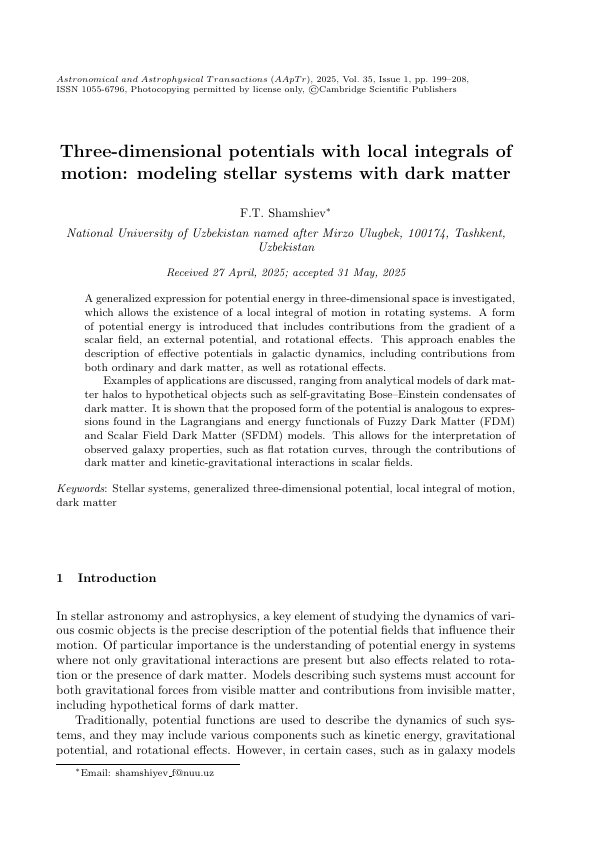
A generalized expression for potential energy in three-dimensional space is investigated, which allows the existence of a local integral of motion in rotating systems. A form of potential energy is introduced that includes contributions from the gradient of a scalar field, an external potential, and rotational effects. This approach enables the description of effective potentials in galactic dynamics, including contributions from both ordinary and dark matter, as well as rotational effects. Examples of applications are discussed, ranging from analytical models of dark matter halos to hypothetical objects such as self-gravitating Bose–Einstein condensates of dark matter. It is shown that the proposed form of the potential is analogous to expressions found in the Lagrangians and energy functionals of Fuzzy Dark Matter (FDM) and Scalar Field Dark Matter (SFDM) models. This allows for the interpretation of observed galaxy properties, such as flat rotation curves, through the contributions of dark matter and kinetic-gravitational interactions in scalar fields.
Abstract
A generalized expression for potential energy in three-dimensional space is investigated, which allows the existence of a local integral of motion in rotating systems. A form of potential energy is introduced that includes contributions from the gradient of a scalar field, an external potential, and rotational effects. This approach enables the description of effective potentials in galactic dynamics, including contributions from both ordinary and dark matter, as well as rotational effects. Examples of applications are discussed, ranging from analytical models of dark matter halos to hypothetical objects such as self-gravitating Bose–Einstein condensates of dark matter. It is shown that the proposed form of the potential is analogous to expressions found in the Lagrangians and energy functionals of Fuzzy Dark Matter (FDM) and Scalar Field Dark Matter (SFDM) models. This allows for the interpretation of observed galaxy properties, such as flat rotation curves, through the contributions of dark matter and kinetic-gravitational interactions in scalar fields.
Lire l’article
PDF de 10 pages, tel qu’imprimé dans la revue, pages 199 à 208. En libre accès.
Pas encore de consultation enregistrée.