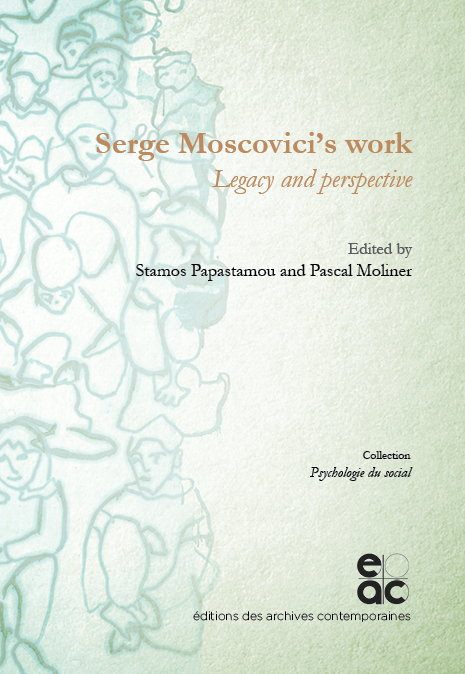
Serge Moscovici’s work


Présentation
We organized recently an international workshop in Greece, to confront our ideas about two major theories of Serge Moscovici. The theory of social representations (1961) and the theory of minority influence (1976). It was a question of tracing the perspectives of the legacy he had left us.
This book is the collective trace of this work. It is organized in three parts. The first part deals with the epistemic and theoretical questions raised by Serge Moscovici’s work. It begins with a historical reminder of his contribution to the formation of the European Association of Social Psychology. The second part of the book presents recent developments in the theory of minority influence. The actual and potential developments of this theory is discussed. The third part is devoted to the theory of social representations. The topics discussed show that this theory has become a reference theory in social sciences for the analysis of societal issues.
One could see in this book a form of homage to the work of Serge Moscovici. But it should above all be seen as a tribute to the liveliness and relevance of the theories he has bequeathed to us.
Sommaire
- Introduction Stamos Papastamou, Pascal Moliner
- PART 1: Historical, epistemological and theoretical issues
- Remembering Serge Moscovici and the making of EASP p. 3–8 Gina Philogène
- A new look on nature and society A tribute to Serge Moscovici p. 9–22 Jorge Correia Jesuino
- Challenges for social representations theory The socio-genetic perspective p. 23–34 Nikos Kalampalikis, Thémis Apostolidis
- The role of installations in building representations and similar practices in a population p. 35–46 Saadi Lahlou
- PART 2: Minority influence
- A suggested revision and extension of Moscovici’s theory of minority influence p. 49–62 William D. Crano
- Implicit theories of influence p. 63–72 Gerasimos Prodromitis, Stamos Papastamou
- From deviant minorities to victimized minorities p. 73–84 Juan Antonio Pérez, Farah Ghosn, Mariángeles Molpeceres
- PART 3: Social representations, politics and society
- The notion of common and social representations p. 87–98 Denise Jodelet
- Jihadism as form of lay thinking A « re anchorage » process hypothesis p. 99–106 Dora Ben Alaya
- The “mild manners” of the Portuguese The persistence of luso-tropicalism through the lens of social representations theory p. 107–116 Valentim Joaquim Pires
- Social representations and pictures of migrants in two French news magazines p. 117–126 Pascal Moliner, Julien Vidal
- Memorials, social representations and collective memory of political repression in Russia p. 127–140 Inna Bovina, Pascal Moliner
- References p. 141–165
Pas encore de consultation enregistrée.