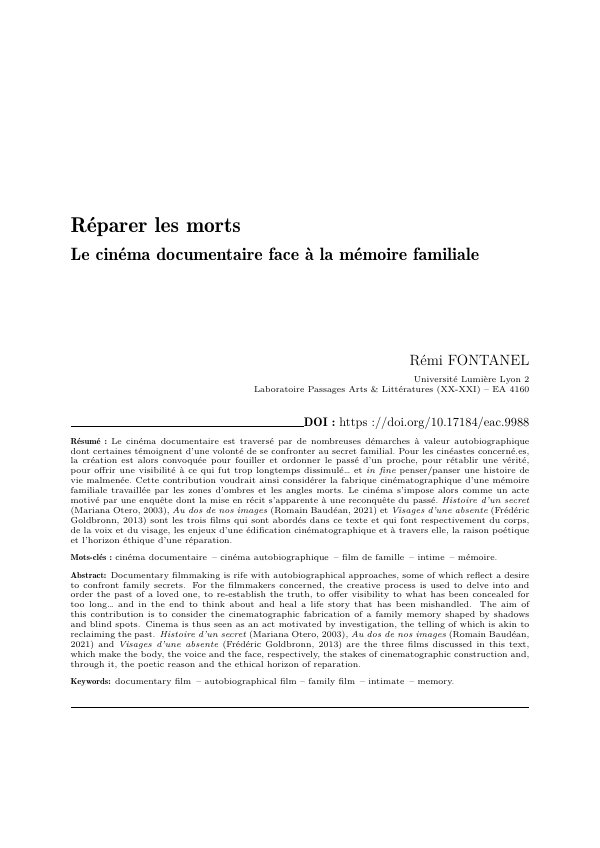
Réparer les morts
- Université Lumière Lyon 2 Laboratoire Passages Arts & Littératures (XX-XXI) – EA 4160
Résumé
Le cinéma documentaire est traversé par de nombreuses démarches à valeur autobiographique dont certaines témoignent d’une volonté de se confronter au secret familial. Pour les cinéastes concerné·es, la création est alors convoquée pour fouiller et ordonner le passé d’un proche, pour rétablir une vérité, pour offrir une visibilité à ce qui fut trop longtemps dissimulé… et in fine penser/panser une histoire de vie malmenée. Cette contribution voudrait ainsi considérer la fabrique cinématographique d’une mémoire familiale travaillée par les zones d’ombres et les angles morts. Le cinéma s’impose alors comme un acte motivé par une enquête dont la mise en récit s’apparente à une reconquête du passé. Histoire d’un secret (Mariana Otero, 2003), Au dos de nos images (Romain Baudéan, 2021) et Visages d’une absente (Frédéric Goldbronn, 2013) sont les trois films qui sont abordés dans ce texte et qui font respectivement du corps, de la voix et du visage, les enjeux d’une édification cinématographique et à travers elle, la raison poétique et l’horizon éthique d’une réparation.
Abstract
Documentary filmmaking is rife with autobiographical approaches, some of which reflect a desire to confront family secrets. For the filmmakers concerned, the creative process is used to delve into and order the past of a loved one, to re-establish the truth, to offer visibility to what has been concealed for too long... and in the end to think about and heal a life story that has been mishandled. The aim of this contribution is to consider the cinematographic fabrication of a family memory shaped by shadows and blind spots. Cinema is thus seen as an act motivated by investigation, the telling of which is akin to reclaiming the past. Histoire d'un secret (Mariana Otero, 2003), Au dos de nos images (Romain Baudéan, 2021) and Visages d'une absente (Frédéric Goldbronn, 2013) are the three films discussed in this text, which make the body, the voice and the face, respectively, the stakes of cinematographic construction and, through it, the poetic reason and the ethical horizon of reparation.
Lire le chapitre
PDF de 11 pages, tel qu’imprimé dans l’ouvrage, pages 25 à 36. En libre accès.
Pas encore de consultation enregistrée.