Water in L1544: 2-phase and 3-phase approaches
Abstract
Water is a vital but poorly constrained component in star-forming regions, with its interstellar origins holding implications for planetary system formation and the deliv- ery of water to terrestrial planets. The prestellar core L1544, a potential precursor to the early Solar System, offers a unique opportunity to study water chemistry in a cold collapsing environment. Using the 1D chemical code Presta, we model the evolution of water in L1544, comparing traditional two-phase (gas + ice) and advanced three-phase (gas + surface ice + bulk ice) approaches. The model incorporates observationally constrained density/temperature profiles and contains a comprehensive chemical net- work. The three-phase approach allows tracking water partitioning between surface and bulk ice reservoirs. Analysis of the reaction rates confirms that gas-phase water primarily originates from grain-surface chemistry. The dominant formation pathway is through the surface reaction s-H + s-OH → s-H<sub>2</sub>O. Immediately upon the formation, the majority (~95%) of water molecules undergo rapid sequestration into the bulk ice phase. The remaining fraction is subject to reactive desorption, a non-thermal process whereby the energy released during surface reactions (in this case, water formation) ejects a part of the products (5%) into the gas phase. This mechanism serves as the primary channel for replenishing gas-phase water in cold, dense environments, maintaining the observed balance between ice mantle growth and molecular gas abundances.
Lire l’article
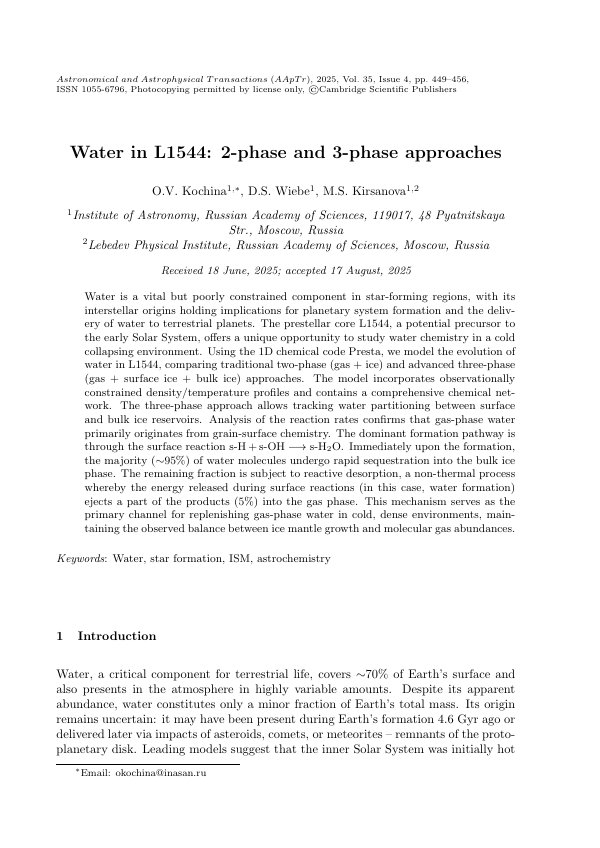
PDF de 8 pages, tel qu’imprimé dans la revue, pages 449 à 456. En libre accès.
Pas encore de consultation enregistrée.