A comprehensive study of spectroscopic binary Cepheids in the Gaia epoch
- 11,3
- 23
- 32,3
Résumé
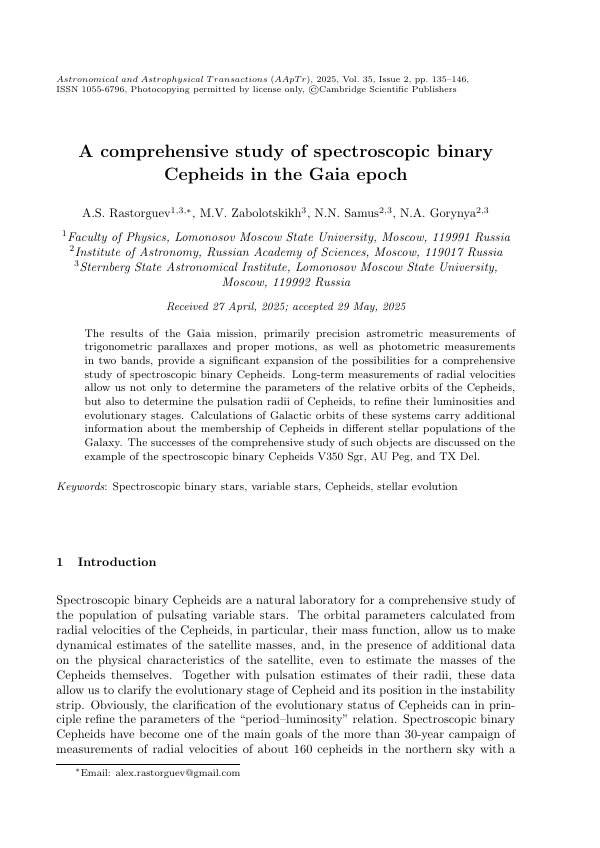
The results of the Gaia mission, primarily precision astrometric measurements of trigonometric parallaxes and proper motions, as well as photometric measurements in two bands, provide a significant expansion of the possibilities for a comprehensive study of spectroscopic binary Cepheids. Long-term measurements of radial velocities allow us not only to determine the parameters of the relative orbits of the Cepheids, but also to determine the pulsation radii of Cepheids, to refine their luminosities and evolutionary stages. Calculations of Galactic orbits of these systems carry additional information about the membership of Cepheids in different stellar populations of the Galaxy. The successes of the comprehensive study of such objects are discussed on the example of the spectroscopic binary Cepheids V350 Sgr, AU Peg, and TX Del.
Abstract
The results of the Gaia mission, primarily precision astrometric measurements of trigonometric parallaxes and proper motions, as well as photometric measurements in two bands, provide a significant expansion of the possibilities for a comprehensive study of spectroscopic binary Cepheids. Long-term measurements of radial velocities allow us not only to determine the parameters of the relative orbits of the Cepheids, but also to determine the pulsation radii of Cepheids, to refine their luminosities and evolutionary stages. Calculations of Galactic orbits of these systems carry additional information about the membership of Cepheids in different stellar populations of the Galaxy. The successes of the comprehensive study of such objects are discussed on the example of the spectroscopic binary Cepheids V350 Sgr, AU Peg, and TX Del.
Lire l’article
PDF de 12 pages, tel qu’imprimé dans la revue, pages 135 à 146. En libre accès.
Pas encore de consultation enregistrée.