Ruminer
Résumé
Si Le normal et le pathologique, thèse et texte central de Canguilhem, semble exhaler de fortes senteurs de nietzschéisme pour un nez averti, pourquoi le nom du penseur allemand ne se trouve-t-il pas plus fréquemment sous la plume du philosophe-médecin? À partir de cet étonnement principiel (ce décalage entre une sympathie de pensées et une discrétion textuelle), ce chapitre s’attache dans un premier temps à évoquer quelques phénomènes qui pourraient conduire Canguilhem, dans le contexte qui est le sien, à masquer son nietzschéisme. En second lieu, au-delà de ces quelques hypothèses formulées, il dresse surtout un état des lieux des opérations par lesquelles l’on peut discerner une ingurgitation-régurgitation ambiguë de Nietzsche. La rumination s’établit alors à des échelles variées et suppose différents types de mouvements; elle s’analyse dans une alternance toujours subtile entre appropriations et rejets. Ressurgit ainsi de manière diffuse, par des bribes éloquentes, des citations détournées, des images et des concepts apparentés, des méthodes similaires, des évaluations et des redéfinitions comparables, un fond d’inspiration nietzschéenne. Assimilé, si ce n’est englouti presque entièrement, jusqu’à en interdire toute mention directe, Nietzsche n’en ressort que plus brillamment du silence qu’on lui demande de tenir. Loin d’être étouffée, de nombreux passages paraissent clamer une affiliation intellectuelle d’autant plus maîtrisée qu’elle est considérable. En définitive, on en viendrait à se demander si Canguilhem n’est pas à certains égards nietzschéen, trop nietzschéen, pour se revendiquer explicitement tel.
Abstract
If one of Canguilhem’s main texts, his dissertation The Normal and the Pathological, seems to exhale some strong Nietzschean smell for one who can detect it, why is the name of the German thinker not mentioned more often by the philosopher-physician? From this original astonishment (the discrepancy between thoughts in appearance alike and an absolute discretion in the text), this chapter first aims at evoking some contextual phenomenons that could lead Canguilhem to conceal his Nietzscheism. Secondly, beyond those brief hypotheses, it above all labels the inventory of multiple operations by which we can observe an equivocal swallowing-regurgitation of Nietzsche. This rumination is thus based on several levels and can go in different directions; it has to be scrutinized as a subtle alternation of appropriations and rejections. This is the reason why a Nietzsche-inspired background comes to the surface in a disseminated way, thanks to enlightening pieces, indirect quotations, resembling images and concepts, similar methods, comparable evaluations and redefinitions. But from this silence he is told to keep, which makes him absorbed if not almost digested and forbids any direct reference, Nietzsche reappears even more noticeable. Far from being wholly dissolved, an intellectual affiliation as controlled as it is important seems indicated many times. Therefore, all things considered, we may wonder if Canguilhem is not Nietzschean, all too Nietzschean, to claim such a legacy.
Lire le chapitre
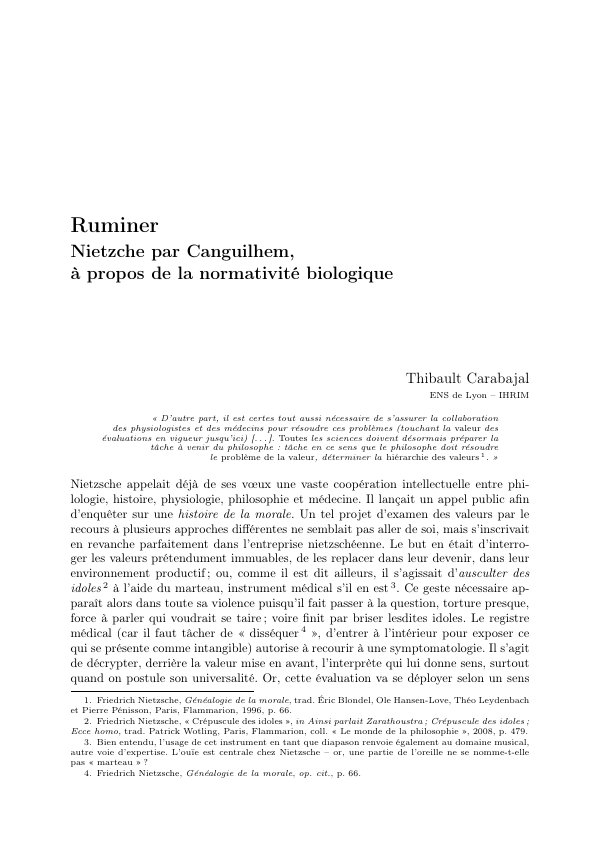
PDF de 22 pages, tel qu’imprimé dans l’ouvrage, pages 311 à 332. En libre accès.
Pas encore de consultation enregistrée.