Combattre
Résumé
L’œuvre de Rousseau figure probablement parmi les corpus philosophiques les plus lus, si la lecture constitue bien une appropriation théorique à même d’actualiser les textes du passé. La médiation de Lévi-Strauss a fait de Rousseau l’un des pères de l’anthropologie, à l’appui d’outils tels que les concepts d’identification, la critique de la civilisation et du progrès ou encore l’attention particulière pour la diversité culturelle. L’œuvre de Rousseau devient ainsi le pilier d’une anthropologie combative, où la capacité de décentrement culturel éloigne de l’amour-propre occidental et formule avec force le lien entre le particulier et le général. Chez Lévi-Strauss comme chez Rousseau, le général se lit à partir du particulier, ou plutôt des particuliers, dans un but à la fois théorique et, pourrait-on dire, militant. La lecture lévistraussienne fait de Rousseau la source d’une anthropologie particulière, qui a pour spécificité de porter le message d’un nouvel humanisme, définissant la connaissance de l’homme comme le vecteur d’affirmation d’une appartenance commune à l’humanité, au-delà des déterminations culturelles.
Abstract
Rousseau’s works are among the most read philosophical corpora, considering that reading can turn out to provoke a theoretical appropriation, able to create a new approach to authors from the past. Levi-Strauss’ mediation turns Rousseau into one of the fathers of anthropology, thanks to theoretical tools such as the concept of identification, civilization and progress’ critics or Rousseau’s particular attention to diversity. Rousseau’s work becomes the cornerstone of a fighting anthropology, where the ability to culturally decenter oneself takes us away from the occidental “amour-propre” and expresses with strength the particular link between the general and the particular. For Levi-Strauss as for Rousseau, the general can be read from the particular, or rather the particulars, both in a theoretical and militant goal. Levi-Strauss’s take on Rousseau turns him into the source of a specific anthropology, which distinguishes itself in conveying the message of a new humanism, to which the knowledge of humankind allows to assert a common humanity, beyond cultural determinations.
Lire le chapitre
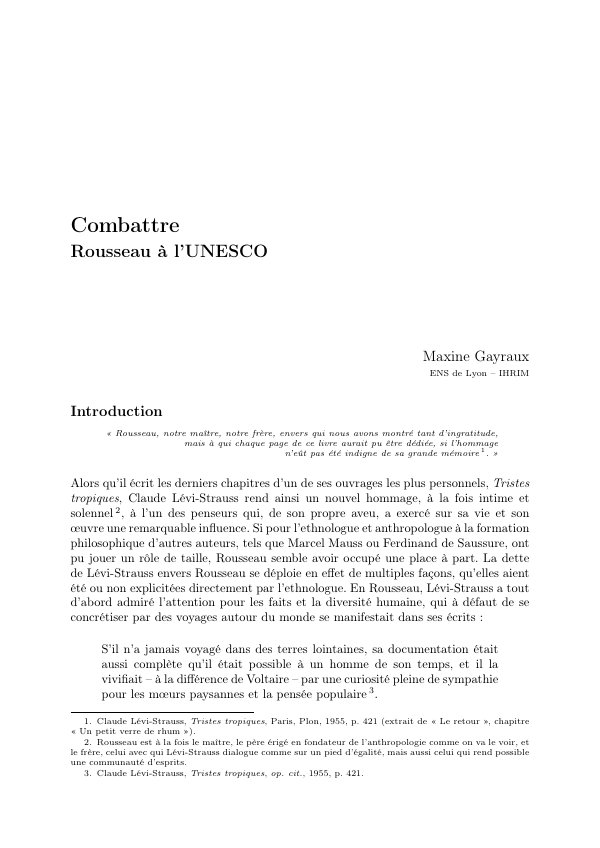
PDF de 24 pages, tel qu’imprimé dans l’ouvrage, pages 271 à 294. En libre accès.
Pas encore de consultation enregistrée.