Réfléchir
Résumé
Pascal – réputé scientifique génial mais sombre moraliste – est surtout célèbre pour ses aphorismes cinglants. Pourtant, l’anthropologie philosophique des Pensées se fonde sur une enquête empirique approfondie, susceptible de représenter la condition humaine déchue dans toutes ses dimensions. Ainsi, il tend un miroir à ses contemporains afin de déclencher une prise de conscience. Ses lecteurs successifs superposent différentes surfaces de réflexion constituant alors un authentique kaléidoscope pascalien éclairant à la fois leur actualité et cette pensée sinueuse. De ce fait, le phénomène optique de la réflexion permet d’envisager l’hybridation actuelle entre un corpus classique et une investigation de terrain. Réfléchir avec Pascal en service d’addictologie, c’est non seulement décomposer les différents rayons conceptuels d’une anthropologie dense à travers le prisme hospitalier, mais c’est aussi entreprendre l’exploration de la galerie des glaces propre à l’expérience addictive au moyen des Pensées: en quoi la déviation des rayons et la déformation des miroirs produit-elle un enrichissement mutuel des deux milieux?
Abstract
Pascal –renowned genius scientist but a dark moralist– is especially famous for his scathing aphorisms. Yet the philosophical anthropology of Les Pensées is based on a thorough empirical inquiry, capable of representing the fallen human condition in all its dimensions. Thus, he hold up a mirror to his contemporaries in order to trigger an awareness. His successive readers superimpose different surfaces of reflection constituting then an authentic Pascalian kaleidoscope illuminating both their own contemporary issues and this sinuous thought. Therefore, the optical phenomenon of reflection makes it possible to envisage the current hybridization between a classical corpus and a fieldwork. Reflecting with Pascal in the service of addictology, it is not only to decompose the different conceptual rays of a dense anthropology through the hospital prism, but it is also to undertake the exploration of the Hall of Mirrors specific to the addictive experience by means of Les Pensées: the deflection of the rays and the deformation of the mirrors produce a mutual enrichment of the two spaces.
Lire le chapitre
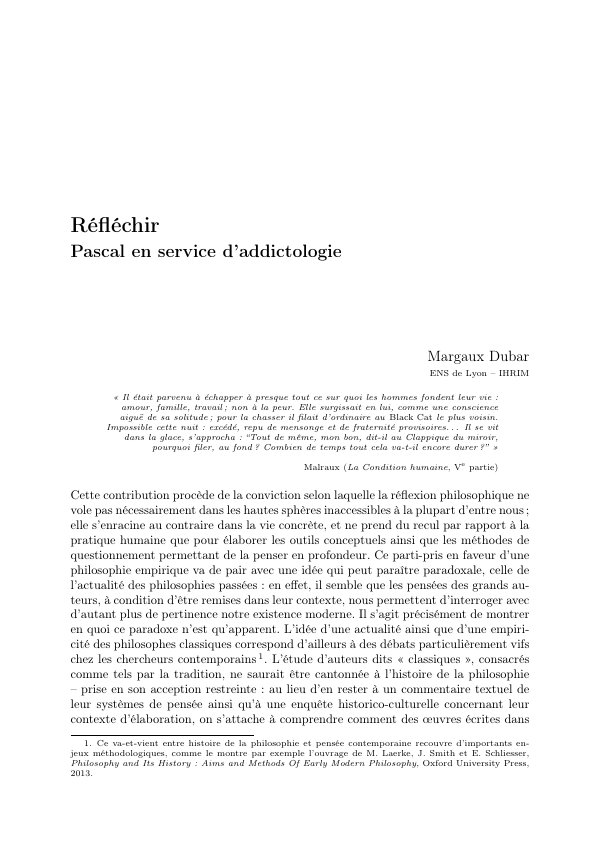
PDF de 20 pages, tel qu’imprimé dans l’ouvrage, pages 205 à 224. En libre accès.
Pas encore de consultation enregistrée.