Réfracter
Résumé
Les textes de Spinoza sont traditionnellement un objet pour l’histoire de la philosophie. Récemment, des entreprises d’actualisation ou d’élucidation philosophique des théories de Spinoza ont étés menées, notamment sur le terrain hospitalier, avec une grande fécondité. Mais elles n’ont pas pour objectif de penser la manière dont se crée une médiation philosophique par l’intermédiaire d’un terrain. J’ai donc cherché comment opérer la création de cette médiation philosophique à l’interface entre les textes de Spinoza et le terrain hospitalier, où se pose de façon cruciale le problème de la spirale de la tristesse: la tristesse n’entraîne-t-elle que la tristesse, comme les idées inadéquates les idées inadéquates? Pour répondre à ce problème, le mécanisme à l’œuvre s’est avéré être la réfraction. Réfracter, c’est remettre en question le «glissé» du domaine épistémologique au domaine éthique, c’est montrer que c’est plutôt un fléchissement qui est en jeu, ce qui permet de souligner le rôle de l’imaginaire dans les affects de tristesse et de joie. Réfracter, c’est réfracter l’enquête de terrain par les textes de Spinoza, puis infléchir les concepts de Spinoza par l’enquête de terrain, et enfin diffracter le champ de la théorie des affects. C’est donc au terme d’un parcours, qui part d’une hypothèse de lecture autour de Spinoza, puis passe par les typologies, résultats du détour par le terrain, pour revenir enfin aux textes de Spinoza, qu’une médiation philosophique a été créée, faisant des concepts de Spinoza de puissants instruments de compréhension du terrain.
Abstract
The texts by Spinoza are traditionally a topic for the history of philosophy. Recently, studies aiming at updating or clarifying philosophical theories by Spinoza have been conducted, particularly in the hospital field very successfully. But they are not intended to think about the way a philosophical mediation is created through workfield. Therefore, I have tried to set up this philosophical mediation between the texts by Spinoza and the hospital ground, where the matter of the spiral of sadness is crucial: does sadness only lead to sadness, as well as inadequate ideas to inadequate ideas? To solve this problem, the working mechanism appeared to be refraction. Refracting, is to challenge the “sliding” from the epistemological domain to the ethical one, it is to show that weakening is rather at stake, which makes it possible to emphasize the role of imagination in the affects of sadness and joy. Refracting, is to refract the field survey with the help of Spinoza’s texts, then to change the concepts of Spinoza by the field survey, and finally to diffract the field of the theory of affects. It is at the end of a journey, which starts with a reading hypothesis about Spinoza, then tackles the typologies, results of the detour across the field, and finally comes back to the texts by Spinoza, that a philosophical mediation has been created, turning Spinoza’s concepts into powerful tools to understand the workfield.
Lire le chapitre
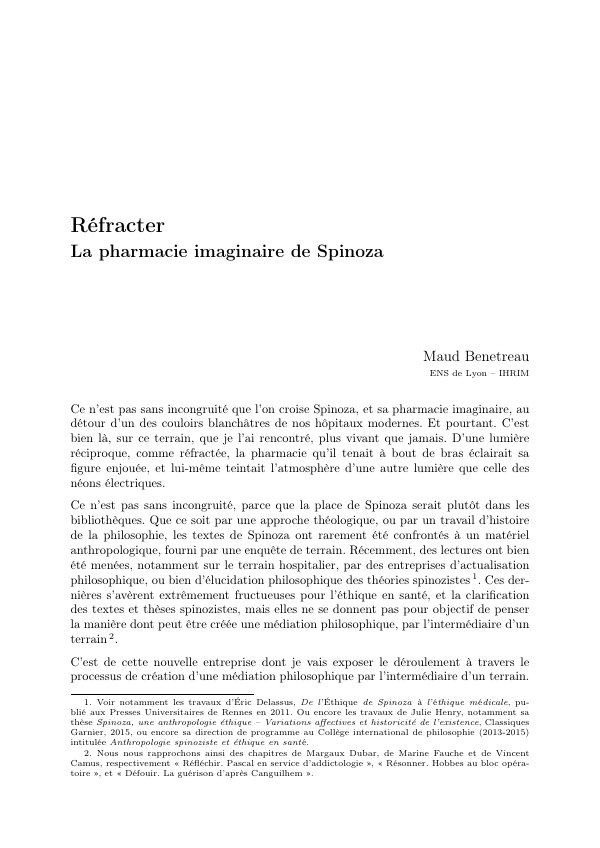
PDF de 16 pages, tel qu’imprimé dans l’ouvrage, pages 155 à 170. En libre accès.
Pas encore de consultation enregistrée.