Mécontenter
Résumé
Frédéric Lordon utilise Spinoza pour penser deux choses: le salariat comme rapport de domination, et les conditions de son renversement. D’un côté, la théorisation du salariat se construit à partir du déterminisme passionnel universel des acteurs, de tous les acteurs, y compris des dominants. Il ne peut dès lors y avoir de responsables de cette structure sociale. D’un autre côté, Lordon théorise à partir de Spinoza ce qui est susceptible de mouvoir un corps politique vers le renversement de ce rapport de domination: l’affect de haine et sa propagation par l’indignation sont mis en avant. Agir politiquement, c’est avant tout mécontenter autrui. Or, la haine et l’indignation ne sont jamais aussi intenses que lorsqu’elles s’attachent à des causes imaginées libres, c’est-à-dire à des personnes imaginées responsables. On remarque d’ailleurs que lorsque Lordon sort du domaine universitaire pour endosser sa casquette de militant, sa rhétorique et ses déclarations véhiculent puissamment cet imaginaire des causes libres et de la responsabilité, et ce afin de renforcer l’indignation de son auditoire. Ainsi, si les productions du Lordon universitaire et du Lordon militant dérivent d’un même spinozisme, elles sont en même temps contradictoires. Lui faut-il alors séparer radicalement la théorie et la pratique, et s’efforcer, pour promouvoir l’indignation, d’oublier le déterminisme universel quand il sort de l’enceinte de l’université? Est-ce que l’approche spinoziste du monde social est contre-productive du point de vue de l’action politique, ou bien peut-elle avoir en elle-même, notamment à travers l’imaginaire déterministe, des effets pratiques?
Abstract
Frédéric Lordon uses Spinoza to theorize two main things : the contemporary forms of exploitation of labour, and the ways to undo them. On the one hand, the organization of labour is theorized through a universal determinism of all agents, even the dominant ones. Therefore his theory cannot pinpoint anyone responsible for this social organization. On the other hand, F. Lordon theorizes the way a social group is led to rise again this exploitation of labour: the affect of hatred, spread through the affect of indignation, are playing the main part in the process. To act on the political level is to lead people to unhappiness. However, hatred and indignation are all the more intense if they are crystalized on the imagination of free-causes, if we imagine that some people are responsible for what makes us unhappy. This is precisely the kind of imaginary conveyed by F. Lordon when he steps out of university to act as a political activist, through his rhetoric and his public declarations. Therefore, even if Lordon-scholar and Lordon-activist derive their activities from the same root –his Spinozism– they are nevertheless contradictory. Is there for Lordon a necessity to branch off practice from theory and to try to forget universal determinism as soon as he steps out from university in order to promote indignation? Does Spinozism lead to the impossibility of collective political action, or does it –through an imaginary of determinism – have in itself practical consequences that can be exploited?
Lire le chapitre
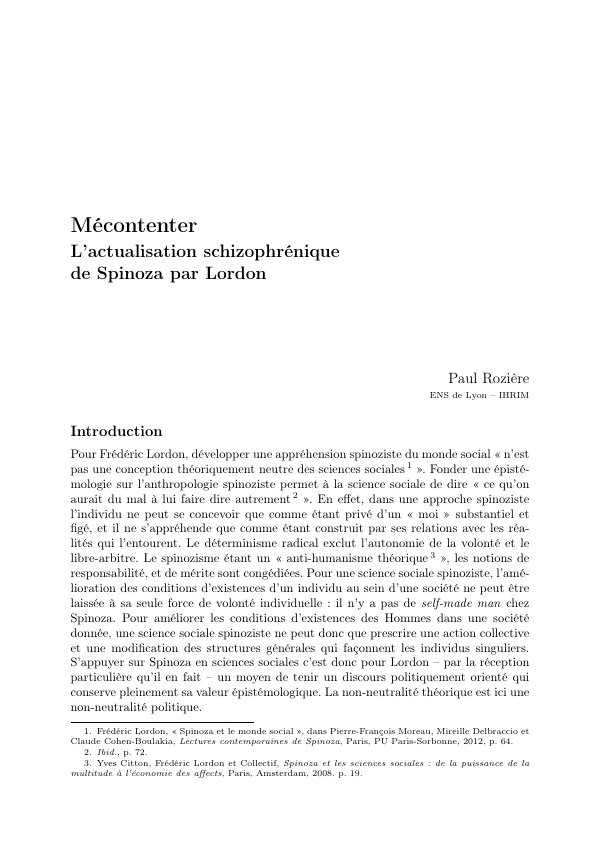
PDF de 17 pages, tel qu’imprimé dans l’ouvrage, pages 137 à 153. En libre accès.
Pas encore de consultation enregistrée.