La santé des enfants protégés: un prendre-soin à la croisée des sphères éducatives et sanitaires
Résumé
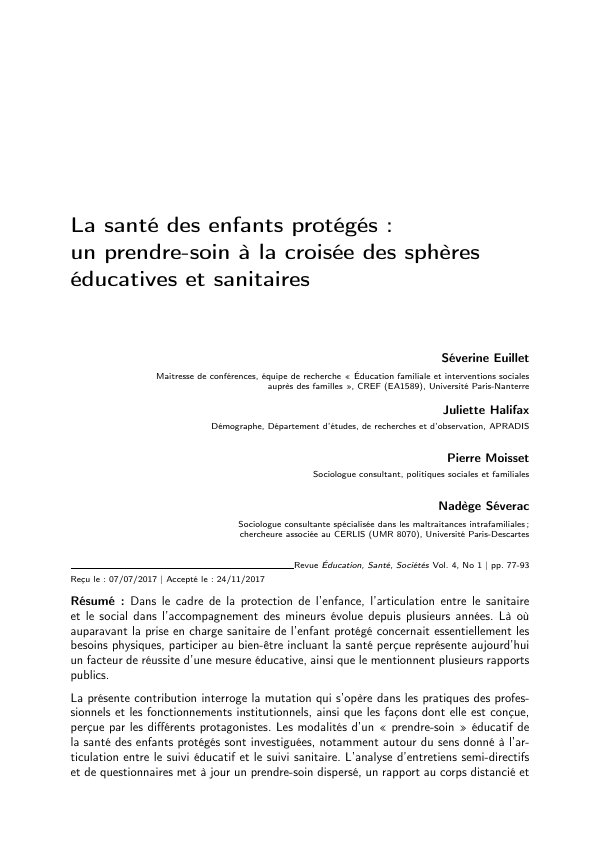
Dans le cadre de la protection de l’enfance, l’articulation entre le sanitaire et le social dans l’accompagnement des mineurs évolue depuis plusieurs années. Là où auparavant la prise en charge sanitaire de l’enfant protégé concernait essentiellement les besoins physiques, participer au bien-être incluant la santé perçue représente aujourd’hui un facteur de réussite d’une mesure éducative, ainsi que le mentionnent plusieurs rapports publics.
La présente contribution interroge la mutation qui s’opère dans les pratiques des professionnels et les fonctionnements institutionnels, ainsi que les façons dont elle est conçue, perçue par les différents protagonistes. Les modalités d’un «prendre-soin» éducatif de la santé des enfants protégés sont investiguées, notamment autour du sens donné à l’articulation entre le suivi éducatif et le suivi sanitaire. L’analyse d’entretiens semi-directifs et de questionnaires met à jour un prendre-soin dispersé, un rapport au corps distancié et une collaboration difficile entre les différents adultes impliqués auprès de l’enfant protégé, venant questionner les représentations des professionnels à propos de ces enfants, mais aussi l’intériorisation d’un prendre-soin de soi par les jeunes eux-mêmes. La préoccupation pour la santé de l’enfant protégé peut alors être conçue comme un révélateur de l’altérité de chacun des acteurs, en lien avec son propre rapport à la santé, aux soins, au corps, aux autres et à soi.
Abstract
Within the framework of child protection, the articulation between the medical and the social sectors in the accompaniment of minors has been evolving for several years now. Where before the protected child’s medical support primarily related to their physical needs, contributing towards their wellness, including their health as perceived, represents a factor of success in the implementation of an educational measure today, as established by several public reports.
The present contribution questions the change taking place in professional practices and institutional mechanisms, as well as the ways in which it is designed and perceived by the various protagonists. The conditions of educational “care-taking” in protected children’s health are investigated, in particular around the meaning given to the articulation between the educational and the medical follow-up.
The analysis of semi-structured interviews and questionnaires unveils dispersed care-taking, a distanced relationship to the body, and difficult collaboration between the different adults involved with the protected child. This comes to question the representations of the professionals regarding these children, but also the appropriation of care-taking by the young people themselves. The concern for the protected child’s health can then be envisaged as a revealing factor of each player’s alterity, in link with their own relationship with health, care, the body, the others and the self.
Lire l’article
PDF de 17 pages, tel qu’imprimé dans la revue, pages 77 à 93. En libre accès.
Pas encore de consultation enregistrée.