Ficción y no ficción en el “caso” Callejas
- Université de Poitiers, CRLA-Archivos Pontificia Universidad Católica de Chile, CELICH-UC
Résumé
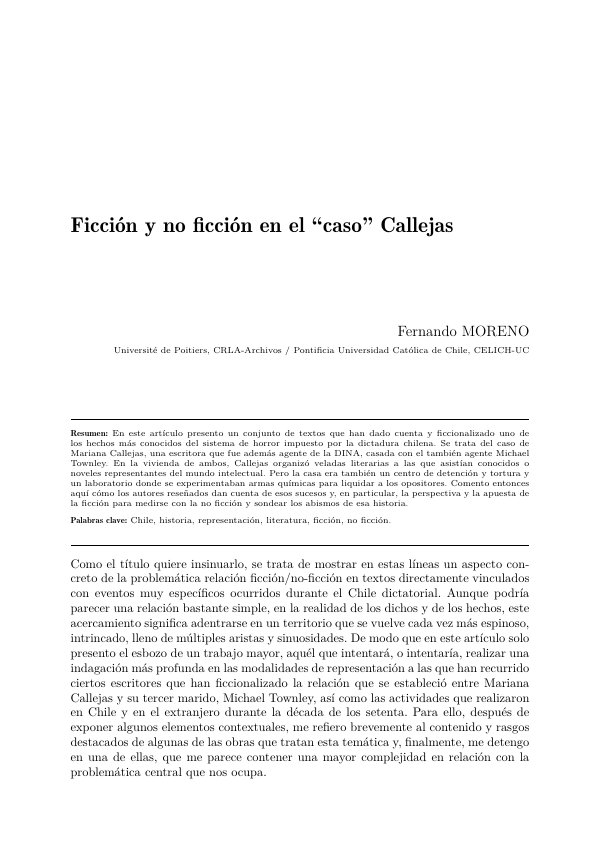
En este artículo presento un conjunto de textos que han dado cuenta y ficcionalizado uno de los hechos más conocidos del sistema de horror impuesto por la dictadura chilena. Se trata del caso de Mariana Callejas, una escritora que fue además agente de la DINA, casada con el también agente Michael Townley. En la vivienda de ambos, Callejas organizó veladas literarias a las que asistían conocidos o noveles representantes del mundo intelectual. Pero la casa era también un centro de detención y tortura y un laboratorio donde se experimentaban armas químicas para liquidar a los opositores. Comento entonces aquí cómo los autores reseñados dan cuenta de esos sucesos y, en particular, la perspectiva y la apuesta de la ficción para medirse con la no ficción y sondear los abismos de esa historia.
Abstract
In this article I present a set of texts that have given an account and fictionalised one of the best known facts of the system of horror imposed by the Chilean dictatorship. It is the case of Mariana Callejas, a writer who was also a DINA agent, married to the agent Michael Townley. At their home, Callejas organised literary evenings attended by well-known and up-and-coming representatives of the intellectual world. But the house was also a detention and torture centre and a laboratory where chemical weapons were tested to liquidate opponents. I comment here on how the authors reviewed give an account of these events and, in particular, the perspective and the use of fiction to measure itself against non-fiction and probe the abysses of this history.
Lire le chapitre
PDF de 11 pages, tel qu’imprimé dans l’ouvrage, pages 145 à 156. En libre accès.
Pas encore de consultation enregistrée.