Claude Esteban y la búsqueda de un nuevo lenguaje. Un testimonio lingüístico del trauma
- Universitat de València
Résumé
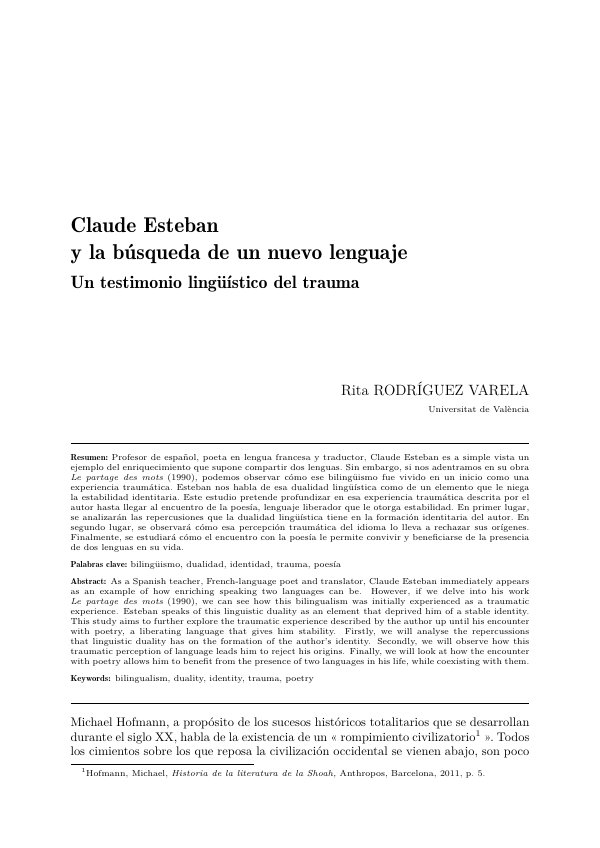
Profesor de español, poeta en lengua francesa y traductor, Claude Esteban es a simple vista un ejemplo del enriquecimiento que supone compartir dos lenguas. Sin embargo, si nos adentramos en su obra Le partage des mots (1990), podemos observar cómo ese bilingüismo fue vivido en un inicio como una experiencia traumática. Esteban nos habla de esa dualidad lingüística como de un elemento que le niega la estabilidad identitaria. Este estudio pretende profundizar en esa experiencia traumática descrita por el autor hasta llegar al encuentro de la poesía, lenguaje liberador que le otorga estabilidad. En primer lugar, se analizarán las repercusiones que la dualidad lingüística tiene en la formación identitaria del autor. En segundo lugar, se observará cómo esa percepción traumática del idioma lo lleva a rechazar sus orígenes. Finalmente, se estudiará cómo el encuentro con la poesía le permite convivir y beneficiarse de la presencia de dos lenguas en su vida.
Abstract
As a Spanish teacher, French-language poet and translator, Claude Esteban immediately appears as an example of how enriching speaking two languages can be. However, if we delve into his work Le partage des mots (1990), we can see how this bilingualism was initially experienced as a traumatic experience. Esteban speaks of this linguistic duality as an element that deprived him of a stable identity. This study aims to further explore the traumatic experience described by the author up until his encounter with poetry, a liberating language that gives him stability. Firstly, we will analyse the repercussions that linguistic duality has on the formation of the author's identity. Secondly, we will observe how this traumatic perception of language leads him to reject his origins. Finally, we will look at how the encounter with poetry allows him to benefit from the presence of two languages in his life, while coexisting with them.
Lire le chapitre
PDF de 10 pages, tel qu’imprimé dans l’ouvrage, pages 217 à 226. En libre accès.
Pas encore de consultation enregistrée.