Acculturation dissonante et bilinguisme sociétal de l’enfant dans Poulailler de Carlos Batista
- Université de Catane
Résumé
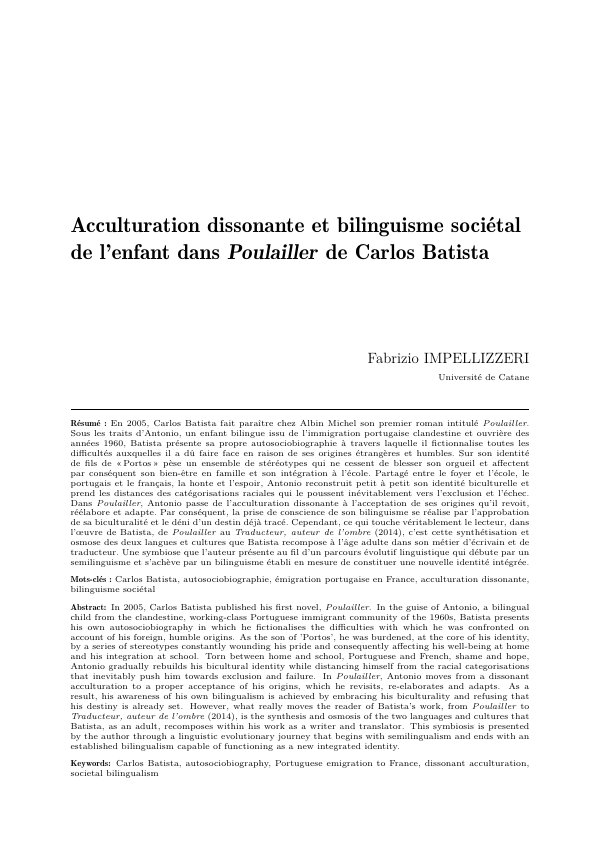
En 2005, Carlos Batista fait paraître chez Albin Michel son premier roman intitulé Poulailler. Sous les traits d’Antonio, un enfant bilingue issu de l’immigration portugaise clandestine et ouvrière des années 1960, Batista présente sa propre autosociobiographie à travers laquelle il fictionnalise toutes les difficultés auxquelles il a dû faire face en raison de ses origines étrangères et humbles. Sur son identité de fils de « Portos » pèse un ensemble de stéréotypes qui ne cessent de blesser son orgueil et affectent par conséquent son bien-être en famille et son intégration à l’école. Partagé entre le foyer et l’école, le portugais et le français, la honte et l’espoir, Antonio reconstruit petit à petit son identité biculturelle et prend les distances des catégorisations raciales qui le poussent inévitablement vers l’exclusion et l’échec. Dans Poulailler, Antonio passe de l’acculturation dissonante à l’acceptation de ses origines qu’il revoit, réélabore et adapte. Par conséquent, la prise de conscience de son bilinguisme se réalise par l’approbation de sa biculturalité et le déni d’un destin déjà tracé. Cependant, ce qui touche véritablement le lecteur, dans l’œuvre de Batista, de Poulailler au Traducteur, auteur de l’ombre (2014), c’est cette synthétisation et osmose des deux langues et cultures que Batista recompose à l’âge adulte dans son métier d’écrivain et de traducteur. Une symbiose que l’auteur présente au fil d’un parcours évolutif linguistique qui débute par un semilinguisme et s’achève par un bilinguisme établi en mesure de constituer une nouvelle identité intégrée.
Abstract
In 2005, Carlos Batista published his first novel, Poulailler. In the guise of Antonio, a bilingual child from the clandestine, working-class Portuguese immigrant community of the 1960s, Batista presents his own autosociobiography in which he fictionalises the difficulties with which he was confronted on account of his foreign, humble origins. As the son of 'Portos', he was burdened, at the core of his identity, by a series of stereotypes constantly wounding his pride and consequently affecting his well-being at home and his integration at school. Torn between home and school, Portuguese and French, shame and hope, Antonio gradually rebuilds his bicultural identity while distancing himself from the racial categorisations that inevitably push him towards exclusion and failure. In Poulailler, Antonio moves from a dissonant acculturation to a proper acceptance of his origins, which he revisits, re-elaborates and adapts. As a result, his awareness of his own bilingualism is achieved by embracing his biculturality and refusing that his destiny is already set. However, what really moves the reader of Batista's work, from Poulailler to Traducteur, auteur de l'ombre (2014), is the synthesis and osmosis of the two languages and cultures that Batista, as an adult, recomposes within his work as a writer and translator. This symbiosis is presented by the author through a linguistic evolutionary journey that begins with semilingualism and ends with an established bilingualism capable of functioning as a new integrated identity.
Lire le chapitre
PDF de 11 pages, tel qu’imprimé dans l’ouvrage, pages 95 à 106. En libre accès.
Pas encore de consultation enregistrée.