Les effets d'un programme d'éducation alimentaire au collège sur les élèves
Résumé
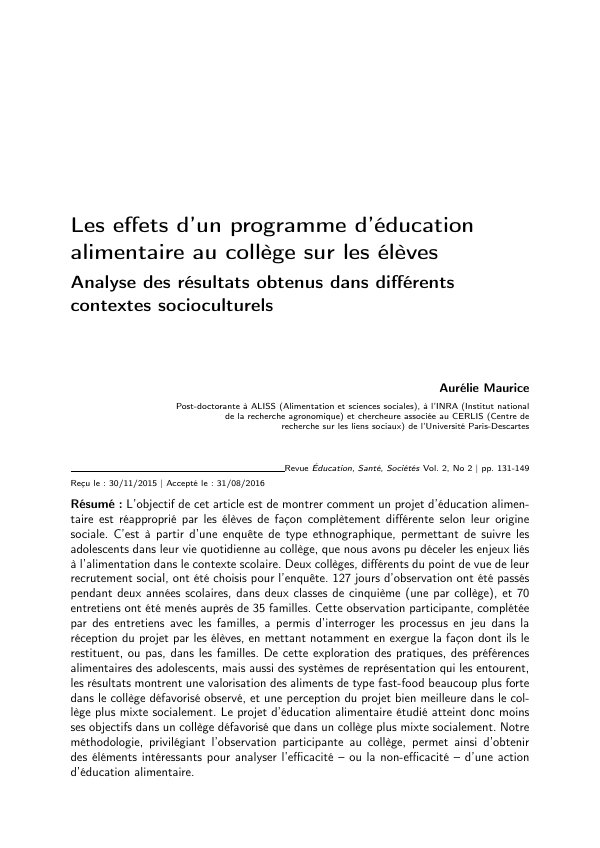
L’objectif de cet article est de montrer comment un projet d’éducation alimentaire est réapproprié par les élèves de façon complètement différente selon leur origine sociale. C’est à partir d’une enquête de type ethnographique, permettant de suivre les adolescents dans leur vie quotidienne au collège, que nous avons pu déceler les enjeux liés à l’alimentation dans le contexte scolaire. Deux collèges, différents du point de vue de leur recrutement social, ont été choisis pour l’enquête. 127 jours d’observation ont été passés pendant deux années scolaires, dans deux classes de cinquième (une par collège), et 70 entretiens ont été menés auprès de 35 familles. Cette observation participante, complétée par des entretiens avec les familles, a permis d’interroger les processus en jeu dans la réception du projet par les élèves, en mettant notamment en exergue la façon dont ils le restituent, ou pas, dans les familles. De cette exploration des pratiques, des préférences alimentaires des adolescents, mais aussi des systèmes de représentation qui les entourent, les résultats montrent une valorisation des aliments de type fast-food beaucoup plus forte dans le collège défavorisé observé, et une perception du projet bien meilleure dans le collège plus mixte socialement. Le projet d’éducation alimentaire étudié atteint donc moins ses objectifs dans un collège défavorisé que dans un collège plus mixte socialement. Notre méthodologie, privilégiant l’observation participante au collège, permet ainsi d’obtenir des éléments intéressants pour analyser l’efficacité – ou la non-efficacité – d’une action d’éducation alimentaire.
Abstract
The objective of this article is to show how a healthy eating education project is re-appropriated by pupils in very different ways depending on their social background. We were able to identify the stakes related to food within the school context thanks to an ethnographic survey, which allowed us to follow teenagers in their daily life at secondary school. Two different secondary schools in terms of social recruitment, were chosen for the survey. 127 days were spent on observation over two school years, in two Year 8 classes (one per school) and 70 interviews were conducted with 35 families. This participant observation was complemented with the interviews carried out with the families. It allowed us to question the processes at stake in the reception of the project by the pupils, by notably highlighting the way in which they present it to their families, or not. Based on this exploration of practices, the food preferences of teenagers, but also the systems of representation which frame them, the results show a stronger appreciation for fast-food type foods in the disadvantaged secondary school and a much better perception of the project in the secondary school with more social diversity. The healthy eating project we studied thus attains fewer of its objectives in a disadvantaged secondary school than in a secondary school with more social diversity. Our methodology, which privileges participant observation at secondary school, thus allows to obtain interesting elements to analyse the efficiency - or lack thereof - of a healthy eating education action.
Lire l’article
PDF de 19 pages, tel qu’imprimé dans la revue, pages 131 à 149. En libre accès.
Pas encore de consultation enregistrée.