Multiwavelength studies of X-ray selected extragalactic sample
Résumé
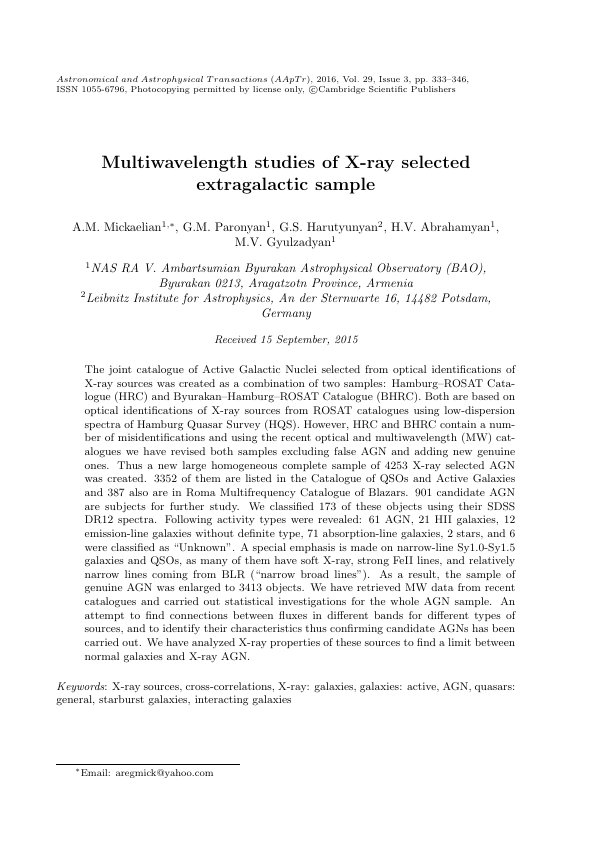
The joint catalogue of Active Galactic Nuclei selected from optical identifications of X-ray sources was created as a combination of two samples: Hambur-ROSAT Catalogue (HRC) and Byuraka-Hambur-ROSAT Catalogue (BHRC). Both are based on optical identifications of X-ray sources from ROSAT catalogues using low-dispersion spectra of Hamburg Quasar Survey (HQS). However, HRC and BHRC contain a number of misidentifications and using the recent optical and multiwavelength (MW) catalogues we have revised both samples excluding false AGN and adding new genuine ones. Thus a new large homogeneous complete sample of 4253 X-ray selected AGN was created. 3352 of them are listed in the Catalogue of QSOs and Active Galaxies and 387 also are in Roma Multifrequency Catalogue of Blazars. 901 candidate AGN are subjects for further study. We classified 173 of these objects using their SDSS DR12 spectra. Following activity types were revealed: 61 AGN, 21 HII galaxies, 12 emission-line galaxies without definite type, 71 absorption-line galaxies, 2 stars, and 6 were classiffied as Unknown". A special emphasis is made on narrow-line Sy1.0-Sy1.5 galaxies and QSOs, as many of them have soft X-ray, strong FeII lines, and relatively narrow lines coming from BLR (arrow broad lines"). As a result, the sample of genuine AGN was enlarged to 3413 objects. We have retrieved MW data from recent catalogues and carried out statistical investigations for the whole AGN sample. An attempt to find connections between uxes in different bands for different types of sources, and to identify their characteristics thus confirming candidate AGNs has been carried out. We have analyzed X-ray properties of these sources to find a limit between normal galaxies and X-ray AGN.
Abstract
The joint catalogue of Active Galactic Nuclei selected from optical identifications of X-ray sources was created as a combination of two samples: Hambur-ROSAT Catalogue (HRC) and Byuraka-Hambur-ROSAT Catalogue (BHRC). Both are based on optical identifications of X-ray sources from ROSAT catalogues using low-dispersion spectra of Hamburg Quasar Survey (HQS). However, HRC and BHRC contain a number of misidentifications and using the recent optical and multiwavelength (MW) catalogues we have revised both samples excluding false AGN and adding new genuine ones. Thus a new large homogeneous complete sample of 4253 X-ray selected AGN was created. 3352 of them are listed in the Catalogue of QSOs and Active Galaxies and 387 also are in Roma Multifrequency Catalogue of Blazars. 901 candidate AGN are subjects for further study. We classified 173 of these objects using their SDSS DR12 spectra. Following activity types were revealed: 61 AGN, 21 HII galaxies, 12 emission-line galaxies without definite type, 71 absorption-line galaxies, 2 stars, and 6 were classiffied as Unknown". A special emphasis is made on narrow-line Sy1.0-Sy1.5 galaxies and QSOs, as many of them have soft X-ray, strong FeII lines, and relatively narrow lines coming from BLR (arrow broad lines"). As a result, the sample of genuine AGN was enlarged to 3413 objects. We have retrieved MW data from recent catalogues and carried out statistical investigations for the whole AGN sample. An attempt to find connections between uxes in different bands for different types of sources, and to identify their characteristics thus confirming candidate AGNs has been carried out. We have analyzed X-ray properties of these sources to find a limit between normal galaxies and X-ray AGN.
Lire l’article
PDF de 14 pages, tel qu’imprimé dans la revue, pages 333 à 346. En libre accès.
Pas encore de consultation enregistrée.