Study of young stellar groupings in H II regions based on the spectral and photometric data
Résumé
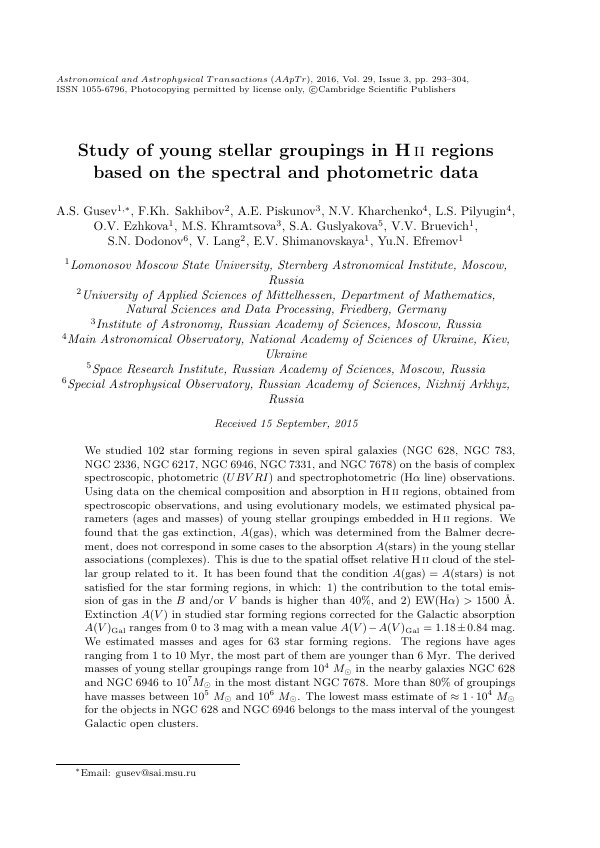
We studied 102 star forming regions in seven spiral galaxies (NGC 628, NGC 783, NGC 2336, NGC 6217, NGC 6946, NGC 7331, and NGC 7678) on the basis of complex spectroscopic, photometric (UBV RI) and spectrophotometric (Hα line) observations. Using data on the chemical composition and absorption in H II regions, obtained from spectroscopic observations, and using evolutionary models, we estimated physical parameters (ages and masses) of young stellar groupings embedded in H II regions. We found that the gas extinction, A(gas), which was determined from the Balmer decrement, does not correspond in some cases to the absorption A(stars) in the young stellar associations (complexes). This is due to the spatial offset relative H II cloud of the stellar group related to it. It has been found that the condition A(gas) = A(stars) is not satisfied for the star forming regions, in which: 1) the contribution to the total emission of gas in the B and/or V bands is higher than 40%, and 2) EW(Hα) > 1500 Å. Extinction A(V ) in studied star forming regions corrected for the Galactic absorption A(V )Gal ranges from 0 to 3 mag with a mean value A(V ) A(V )Gal = 1:18 0:84 mag. We estimated masses and ages for 63 star forming regions. The regions have ages ranging from 1 to 10 Myr, the most part of them are younger than 6 Myr. The derived masses of young stellar groupings range from 104 M in the nearby galaxies NGC 628 and NGC 6946 to 107M in the most distant NGC 7678. More than 80% of groupings have masses between 105 M and 106 M . The lowest mass estimate of 1 104 M for the objects in NGC 628 and NGC 6946 belongs to the mass interval of the youngest Galactic open clusters.§
Abstract
We studied 102 star forming regions in seven spiral galaxies (NGC 628, NGC 783, NGC 2336, NGC 6217, NGC 6946, NGC 7331, and NGC 7678) on the basis of complex spectroscopic, photometric (UBV RI) and spectrophotometric (Hα line) observations. Using data on the chemical composition and absorption in H II regions, obtained from spectroscopic observations, and using evolutionary models, we estimated physical parameters (ages and masses) of young stellar groupings embedded in H II regions. We found that the gas extinction, A(gas), which was determined from the Balmer decrement, does not correspond in some cases to the absorption A(stars) in the young stellar associations (complexes). This is due to the spatial offset relative H II cloud of the stellar group related to it. It has been found that the condition A(gas) = A(stars) is not satisfied for the star forming regions, in which: 1) the contribution to the total emission of gas in the B and/or V bands is higher than 40%, and 2) EW(Hα) > 1500 Å. Extinction A(V ) in studied star forming regions corrected for the Galactic absorption A(V )Gal ranges from 0 to 3 mag with a mean value A(V ) A(V )Gal = 1:18 0:84 mag. We estimated masses and ages for 63 star forming regions. The regions have ages ranging from 1 to 10 Myr, the most part of them are younger than 6 Myr. The derived masses of young stellar groupings range from 104 M in the nearby galaxies NGC 628 and NGC 6946 to 107M in the most distant NGC 7678. More than 80% of groupings have masses between 105 M and 106 M . The lowest mass estimate of 1 104 M for the objects in NGC 628 and NGC 6946 belongs to the mass interval of the youngest Galactic open clusters.§
Lire l’article
PDF de 12 pages, tel qu’imprimé dans la revue, pages 293 à 304. En libre accès.
Pas encore de consultation enregistrée.