Transcrire un corpus audio dans la perspective de la préservation du patrimoine culturel immatériel.
- Cy Cergy Paris université
Résumé
Résumés
Marie-Madeleine Bertucci
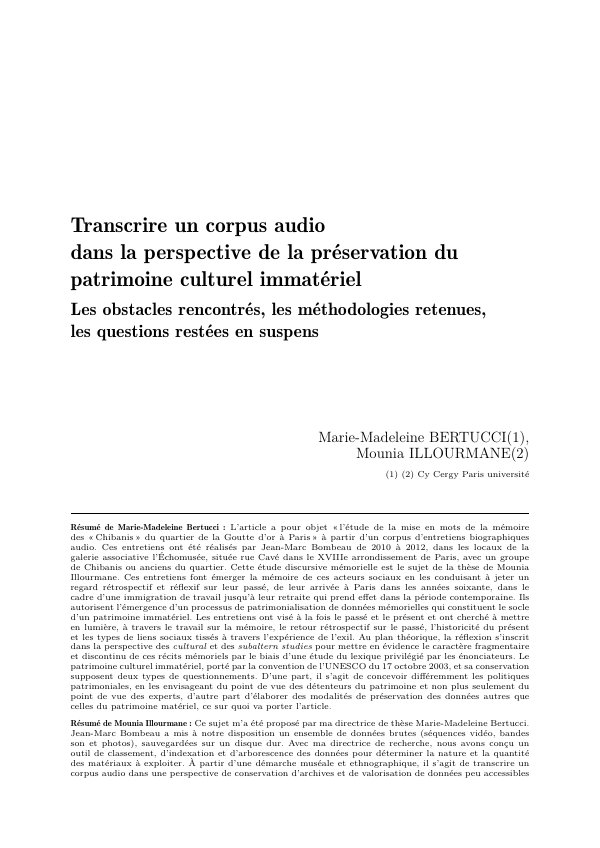
L’article a pour objet « l’étude de la mise en mots de la mémoire des « Chibanis » du quartier de la Goutte d’or à Paris » à partir d’un corpus d’entretiens biographiques audio. Ces entretiens ont été réalisés par Jean-Marc Bombeau, dans les locaux de la galerie associative l’Échomusée, située rue Cavé dans le XVIIIe arrondissement de Paris, avec un groupe de Chibanis ou anciens du quartier de 2010 à 2012. Cette étude discursive mémorielle est le sujet de la thèse de Mounia Illourmane. Ces entretiens font émerger la mémoire de ces acteurs sociaux en les conduisant à jeter un regard rétrospectif et réflexif sur leur passé, de leur arrivée à Paris dans les années soixante, dans le cadre d’une immigration de travail jusqu’à leur retraite qui prend effet dans la période contemporaine. Ils autorisent l’émergence d’un processus de patrimonialisation de données mémorielles qui constituent le socle d’un patrimoine immatériel. Les entretiens ont visé à la fois le passé et le présent et ont cherché à mettre en lumière, à travers le travail sur la mémoire, le retour rétrospectif sur le passé, l’historicité du présent et les types de liens sociaux tissés à travers l’expérience de l’exil. Au plan théorique, la réflexion s’inscrit dans la perspective des cultural et des subaltern studies pour mettre en évidence le caractère fragmentaire et discontinu de ces récits mémoriels par le biais d’une étude du lexique privilégié par les énonciateurs. Le patrimoine culturel immatériel, porté par la convention de l’UNESCO du 17 octobre 2003, et sa conservation supposent deux types de questionnements. D’une part, il s’agit de concevoir différemment les politiques patrimoniales, en les envisageant du point de vue des détenteurs du patrimoine et non plus seulement du point de vue des experts, d’autre part d’élaborer des modalités de préservation des données autres que celles du patrimoine matériel, ce sur quoi va porter l’article.
Mounia Illourmane
Ce sujet m’a été proposé par ma directrice de thèse Marie-Madeleine Bertucci. Jean-Marc Bombeau a mis à notre disposition un ensemble de données brutes (séquences vidéo, bandes son et photos), sauvegardées sur un disque dur. Avec ma directrice de recherche, nous avons conçu un outil de classement, d’indexation et d’arborescence des données pour déterminer la nature et la quantité des matériaux à exploiter. À partir d’une démarche muséale et ethnographique, il s'agit de transcrire un corpus audio dans une perspective de conservation d'archives et de valorisation de données peu accessibles matériellement et s’inscrivant dans le cadre du patrimoine culturel immatériel. Néanmoins au cours de cette tâche, sont apparues certaines difficultés d'ordre technique, étant donné que le corpus n'est pas destiné à cet effet, la prise de son est artisanale ce qui a rendu la transcription plus complexe. Face à des locuteurs non natifs avec un accent prononcé, les logiciels de reconnaissance vocale et de transcription automatique sont inadaptés. Par conséquent, le choix des outils s'est porté sur deux logiciels informatiques, « Express Scribe » et « E-Speaking ». Le premier est un logiciel professionnel de lecture audio conçu pour faciliter la transcription des enregistrements audio. Grâce à cet outil on peut contrôler la vitesse de lecture audio ainsi avoir une lecture à vitesse variable. « E-Speaking » est un logiciel de contrôle et de reconnaissance vocale qui a pour fonction la dictée et l'exécution des tâches sur ordinateur avec la voix de l'utilisateur. On l’a utilisé notamment pour accélérer le travail de transcription des bandes son. L'emploi de ces deux outils a permis la transcription en restant le plus fidèlement possible à l'original tout en tenant compte des nombreuses contraintes d'ordre syntaxique, orthographique et phonologique résultant du caractère oral des données.
Abstract
Marie-Madeleine Bertucci
The purpose of the paper is "the study of the mise en mots of the memory of the "Chibanis" of the Goutte d'or district in Paris" based on a corpus of audio biographical interviews conducted by Jean-Marc Bombeau, in the premises of the Echomusée gallery, located rue Cavé in the 18th arrondissement of Paris, with a group of Chibanis or former members of the district from 2010 to 2012. This discursive memory study is the subject of Mounia Illourmane's thesis. These interviews bring out the memory of these social actors by leading them to take a retrospective and reflexive look at their past, from their arrival in Paris in the 1960s, in the context of labour immigration, to their retirement which takes effect in the contemporary period. They allow the emergence of a process of patrimonialization of memory data, which constitutes the basis of an intangible heritage. The interviews focused on both the past and the present and sought to highlight, through the work on memory, the retrospective look back at the past, the historicity of the present and the types of social ties forged through the experience of exile. On the theoretical level, the reflection is part of the perspective of cultural and subordinate studies to highlight the fragmentary and discontinuous nature of these memory narratives through a study of the lexicon favoured by enunciators. The intangible cultural heritage, supported by the UNESCO Convention of 17 October 2003, and its conservation involve two types of questioning. On the one hand, it is a question of conceiving heritage policies differently, by considering them from the point of view of heritage holders and no longer only from the point of view of experts, and on the other hand of developing methods for preserving data other than those of the tangible heritage, which is what the paper will cover.
Mounia Illourmane
This subject was proposed to me by my thesis supervisor Marie-Madeleine Bertucci. Jean-Marc Bombeau provided us with a set of raw data (video sequences, soundtracks and photos), saved on a hard disk. With my research director, we developed a data classification, indexing and tree structure tool to determine the nature and quantity of materials to be used. Based on a museum and ethnographic approach, it is a question of transcribing an audio corpus from the perspective of archive conservation and the enhancement of data that are not easily accessible in material terms and that are part of the intangible cultural heritage. Nevertheless, during this task, some technical difficulties appeared, since the corpus is not intended for this purpose, the sound recording is artisanal, which made the transcription more complex. In the case of non-native speakers with a pronounced accent, speech recognition and automatic transcription software are inadequate. Consequently, the choice of tools was made between two computer programs, "Express Scribe" and "E-Speaking". The first is a professional audio playback software designed to facilitate the transcription of audio recordings. Thanks to this tool we can control the speed of audio playback as well as have a variable speed playback. "E-Speaking" is a speech control and recognition software that is used to dictation and perform tasks on a computer with the user's voice. It has been used, in particular, to speed up the transcription of soundtracks. The use of these two tools allowed the transcription to be made as close as possible to the original while taking into account the many syntactic, orthographic and phonological constraints resulting from the oral nature of the data.
Lire le chapitre
PDF de 10 pages, tel qu’imprimé dans l’ouvrage, pages 115 à 124. En libre accès.
Pas encore de consultation enregistrée.