Starspot activity of some close binary systems
Résumé
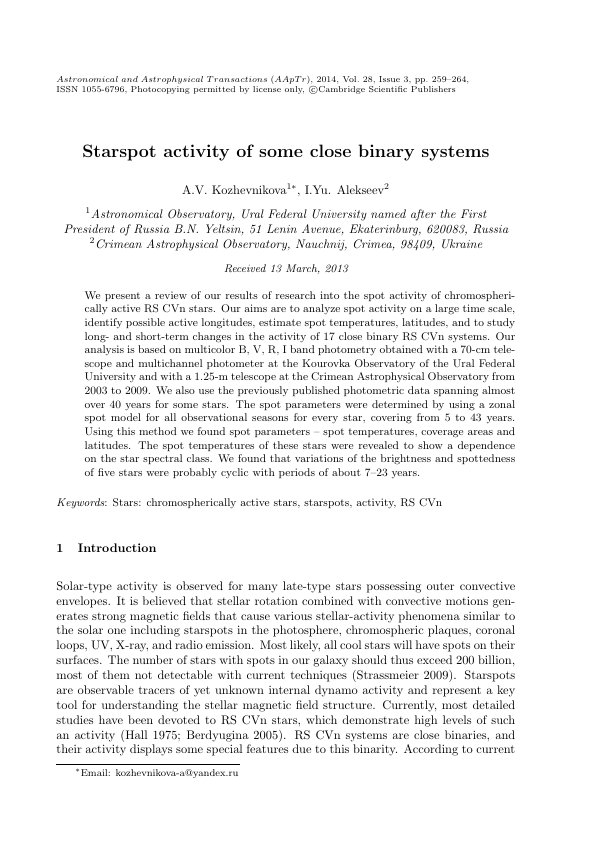
<p>We present a review of our results of research into the spot activity of chromospherically active RS CVn stars. Our aims are to analyze spot activity on a large time scale, identify possible active longitudes, estimate spot temperatures, latitudes, and to study long-and short-term changes in the activity of 17 close binary RS CVn systems. Our analysis is based on multicolor B, V, R, I band photometry obtained with a 70-cm telescope and multichannel photometer at the Kourovka Observatory of the Ural Federal University and with a 1.25-m telescope at the Crimean Astrophysical Observatory from 2003 to 2009. We also use the previously published photometric data spanning almost over 40 years for some stars. The spot parameters were determined by using a zonal spot model for all observational seasons for every star, covering from 5 to 43 years. Using this method we found spot parameters – spot temperatures, coverage areas and latitudes. The spot temperatures of these stars were revealed to show a dependence on the star spectral class. We found that variations of the brightness and spottedness of five stars were probably cyclic with periods of about 7–23 years.</p>
Abstract
<p>We present a review of our results of research into the spot activity of chromospherically active RS CVn stars. Our aims are to analyze spot activity on a large time scale, identify possible active longitudes, estimate spot temperatures, latitudes, and to study long-and short-term changes in the activity of 17 close binary RS CVn systems. Our analysis is based on multicolor B, V, R, I band photometry obtained with a 70-cm telescope and multichannel photometer at the Kourovka Observatory of the Ural Federal University and with a 1.25-m telescope at the Crimean Astrophysical Observatory from 2003 to 2009. We also use the previously published photometric data spanning almost over 40 years for some stars. The spot parameters were determined by using a zonal spot model for all observational seasons for every star, covering from 5 to 43 years. Using this method we found spot parameters – spot temperatures, coverage areas and latitudes. The spot temperatures of these stars were revealed to show a dependence on the star spectral class. We found that variations of the brightness and spottedness of five stars were probably cyclic with periods of about 7–23 years.</p>
Lire l’article
PDF de 6 pages, tel qu’imprimé dans la revue, pages 259 à 264. En libre accès.
Pas encore de consultation enregistrée.