Preface
Résumé
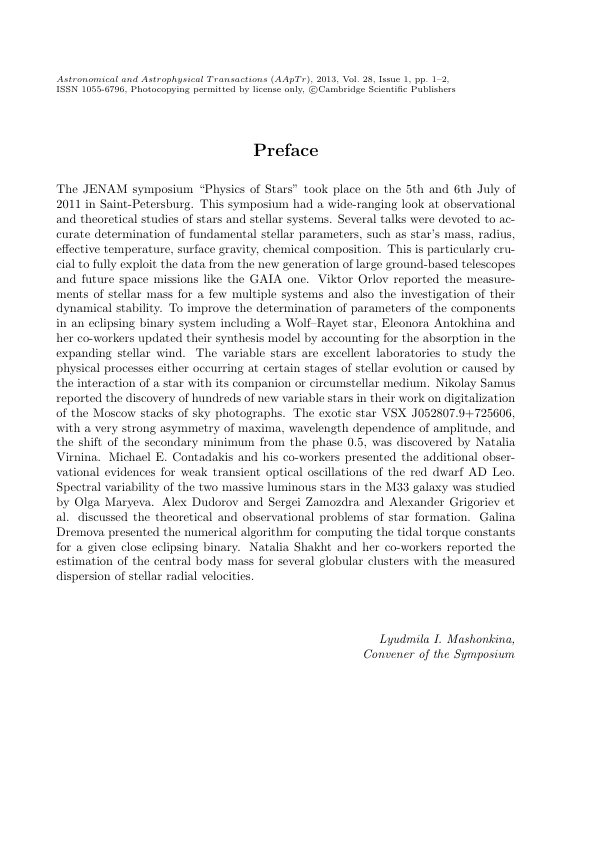
The JENAM symposium “Physics of Stars” took place on the 5th and 6th July of 2011 in Saint-Petersburg. This symposium had a wide-ranging look at observational and theoretical studies of stars and stellar systems. Several talks were devoted to accurate determination of fundamental stellar parameters, such as star’s mass, radius, e?ective temperature, surface gravity, chemical composition. This is particularly crucial to fully exploit the data from the new generation of large ground-based telescopes and future space missions like the GAIA one. Viktor Orlov reported the measurements of stellar mass for a few multiple systems and also the investigation of their dynamical stability. To improve the determination of parameters of the components in an eclipsing binary system including a Wolf–Rayet star, Eleonora Antokhina and her co-workers updated their synthesis model by accounting for the absorption in the expanding stellar wind. The variable stars are excellent laboratories to study the physical processes either occurring at certain stages of stellar evolution or caused by the interaction of a star with its companion or circumstellar medium. Nikolay Samus reported the discovery of hundreds of new variable stars in their work on digitalization of the Moscow stacks of sky photographs. The exotic star VSX J052807.9+725606, with a very strong asymmetry of maxima, wavelength dependence of amplitude, and the shift of the secondary minimum from the phase 0.5, was discovered by Natalia Virnina. Michael E. Contadakis and his co-workers presented the additional observational evidences for weak transient optical oscillations of the red dwarf AD Leo. Spectral variability of the two massive luminous stars in the M33 galaxy was studied by Olga Maryeva. Alex Dudorov and Sergei Zamozdra and Alexander Grigoriev et al. discussed the theoretical and observational problems of star formation. Galina Dremova presented the numerical algorithm for computing the tidal torque constants for a given close eclipsing binary. Natalia Shakht and her coworkers reported the estimation of the central body mass for several globular clusters with the measured dispersion of stellar radial velocities
Abstract
The JENAM symposium “Physics of Stars” took place on the 5th and 6th July of 2011 in Saint-Petersburg. This symposium had a wide-ranging look at observational and theoretical studies of stars and stellar systems. Several talks were devoted to accurate determination of fundamental stellar parameters, such as star’s mass, radius, e?ective temperature, surface gravity, chemical composition. This is particularly crucial to fully exploit the data from the new generation of large ground-based telescopes and future space missions like the GAIA one. Viktor Orlov reported the measurements of stellar mass for a few multiple systems and also the investigation of their dynamical stability. To improve the determination of parameters of the components in an eclipsing binary system including a Wolf–Rayet star, Eleonora Antokhina and her co-workers updated their synthesis model by accounting for the absorption in the expanding stellar wind. The variable stars are excellent laboratories to study the physical processes either occurring at certain stages of stellar evolution or caused by the interaction of a star with its companion or circumstellar medium. Nikolay Samus reported the discovery of hundreds of new variable stars in their work on digitalization of the Moscow stacks of sky photographs. The exotic star VSX J052807.9+725606, with a very strong asymmetry of maxima, wavelength dependence of amplitude, and the shift of the secondary minimum from the phase 0.5, was discovered by Natalia Virnina. Michael E. Contadakis and his co-workers presented the additional observational evidences for weak transient optical oscillations of the red dwarf AD Leo. Spectral variability of the two massive luminous stars in the M33 galaxy was studied by Olga Maryeva. Alex Dudorov and Sergei Zamozdra and Alexander Grigoriev et al. discussed the theoretical and observational problems of star formation. Galina Dremova presented the numerical algorithm for computing the tidal torque constants for a given close eclipsing binary. Natalia Shakht and her coworkers reported the estimation of the central body mass for several globular clusters with the measured dispersion of stellar radial velocities
Lire l’article
PDF de 2 pages, tel qu’imprimé dans la revue, pages 1 à 2. En libre accès.
Pas encore de consultation enregistrée.