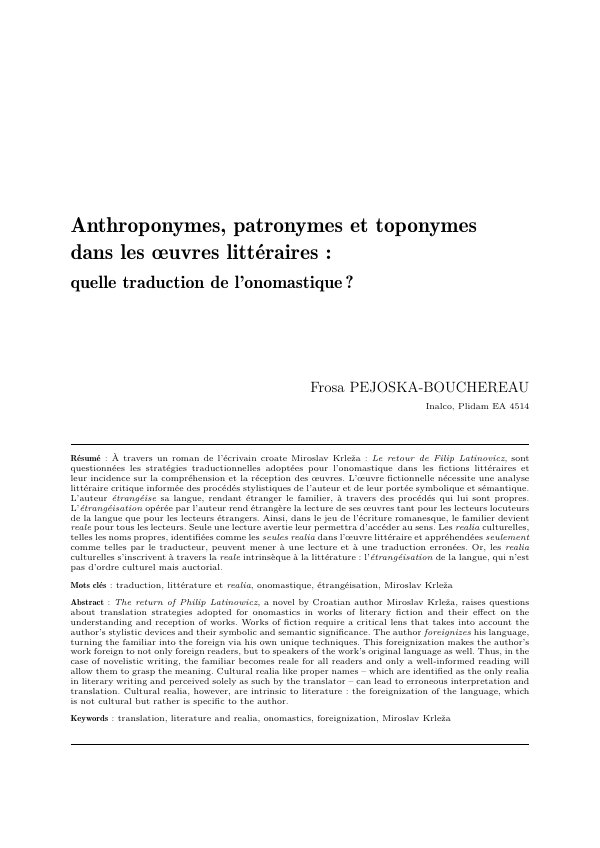
Anthroponymes, patronymes et toponymes dans les œuvres littéraires : quelle traduction de l’onomastique ?
- Inalco, Plidam EA 4514
Résumé
L’article propose une réflexion sur les difficultés de traduire et appréhender les realia à l’intérieur d’une même langue, quand les univers culturels de référence sont très éloignés. Deux exemples sont présentés : la manière dont George Sand écrit François le Champi en restant fidèle au monde champêtre tout en s’adressant aux « Parisiens » et la manière dont Patrick Chamoiseau, dans son récit autobiographique Chemin-d’école, restitue le point de vue d’un enfant créole découvrant l’étrangeté des références culturelles métropolitaines enseignées à l’école.
Abstract
The return of Philip Latinowicz, a novel by Croatian author Miroslav Krleža, raises questions about translation strategies adopted for onomastics in works of literary fiction and their effect on the understanding and reception of works. Works of fiction require a critical lens that takes into account the author’s stylistic devices and their symbolic and semantic significance. The author foreignizes his language, turning the familiar into the foreign via his own unique techniques. This foreignization makes the author’s work foreign to not only foreign readers, but to speakers of the work’s original language as well. Thus, in the case of novelistic writing, the familiar becomes reale for all readers and only a well-informed reading will allow them to grasp the meaning. Cultural realia like proper names – which are identified as the only realia in literary writing and perceived solely as such by the translator – can lead to erroneous interpretation and translation. Cultural realia, however, are intrinsic to literature: the foreignization of the language, which is not cultural but rather is specific to the author.
Lire le chapitre
PDF de 20 pages, tel qu’imprimé dans l’ouvrage, pages 11 à 30. En libre accès.
Pas encore de consultation enregistrée.