Impact du dispositif Universanté sur les représentations du sport d’étudiants en STAPS
- 1Docteur en STAPS - Université du Littoral Côte d’Opale - URePSSS
- 2PRAG EPS - STAPS - Université du Littoral Côte d’Opale - URePSSS
- 3MCF en STAPS - Université de Lille - URePSSS
- 4MCF en STAPS – Université de Lille - URePSSS
- 5MCF en STAPS- Université du Littoral Côte d’Opale- URePSSS
- 6MCF en STAPS - Université de Lille- URePSSS
- 7MCF en STAPS - Université du Littoral Côte d’Opale - URePSSS
Résumé
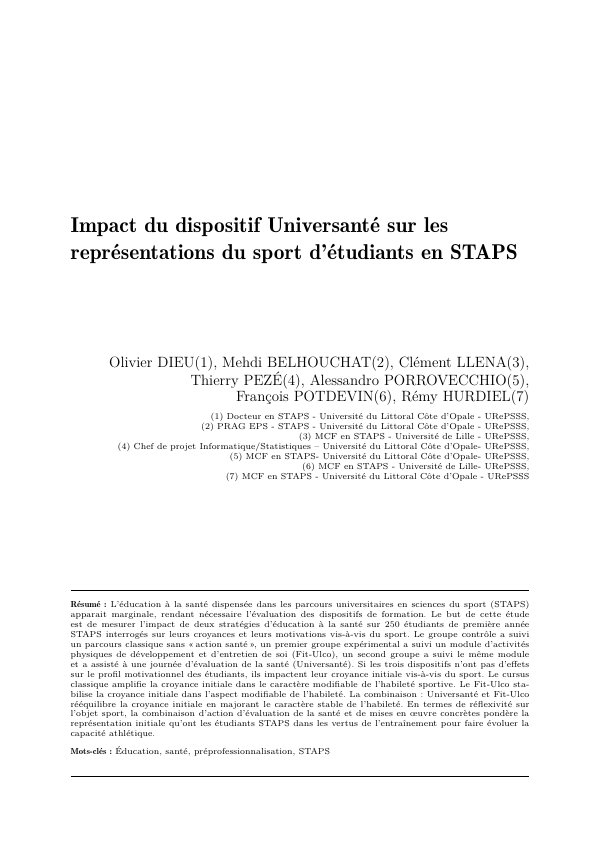
L’éducation à la santé dispensée dans les parcours universitaires en sciences du sport (STAPS) apparait marginale, rendant nécessaire l’évaluation des dispositifs de formation. Le but de cette étude est de mesurer l’impact de deux stratégies d’éducation à la santé sur 250 étudiants de première année STAPS interrogés sur leurs croyances et leurs motivations vis-à-vis du sport. Le groupe contrôle a suivi un parcours classique sans « action santé », un premier groupe expérimental a suivi un module d’activités physiques de développement et d’entretien de soi (Fit-Ulco), un second groupe a suivi le même module et a assisté à une journée d’évaluation de la santé (Universanté). Si les trois dispositifs n’ont pas d’effets sur le profil motivationnel des étudiants, ils impactent leur croyance initiale vis-à-vis du sport. Le cursus classique amplifie la croyance initiale dans le caractère modifiable de l’habileté sportive. Le Fit-Ulco stabilise la croyance initiale dans l’aspect modifiable de l’habileté. La combinaison : Universanté et Fit-Ulco rééquilibre la croyance initiale en majorant le caractère stable de l’habileté. En termes de réflexivité sur l’objet sport, la combinaison d’action d’évaluation de la santé et de mises en œuvre concrètes pondère la représentation initiale qu’ont les étudiants STAPS dans les vertus de l’entraînement pour faire évoluer la capacité athlétique.
Abstract
In France, health education in sport science university courses (STAPS) appears to be marginal, making it necessary to evaluate the training systems. The aim of this study is to measure the impact of two health education strategies on 250 first year STAPS students who were questioned about their beliefs and motivations towards sport. The control group followed a classic course without any specific "health scheme”; the first experimental group followed a physical activity module for self-development and maintenance (Fit-Ulco); the second group followed the same module and attended a health assessment day (Universanté). While the three programmes had no effect on the students' motivational profiles, they did impact their initial belief regarding sport. The classical curriculum amplifies the initial belief in the modifiable nature of ability in sport. Fit-Ulco stabilises the initial belief in the modifiable aspect of the ability. The association of Universanté and Fit-Ulco rebalances this initial belief by magnifying the stable nature of the ability. In terms of reflexivity on the object of sport, the combination of health assessment and concrete implementation counterbalances the initial representation that STAPS students have in the virtues of training to improve athletic capacity.
Lire l’article
PDF de 24 pages, tel qu’imprimé dans la revue, pages 175 à 198. En libre accès.
Pas encore de consultation enregistrée.