J. Huang’s "Grand contemporary chinese-french dictionary (2014)" and the story behind it
- 1Directeur du Centre des études lexicographiques, Université des études étrangères du Guangdong (Chine)
- 2Maître de Conférences, Centre des études lexicographiques, Université des études étrangères du Guangdong (Chine)
Résumé
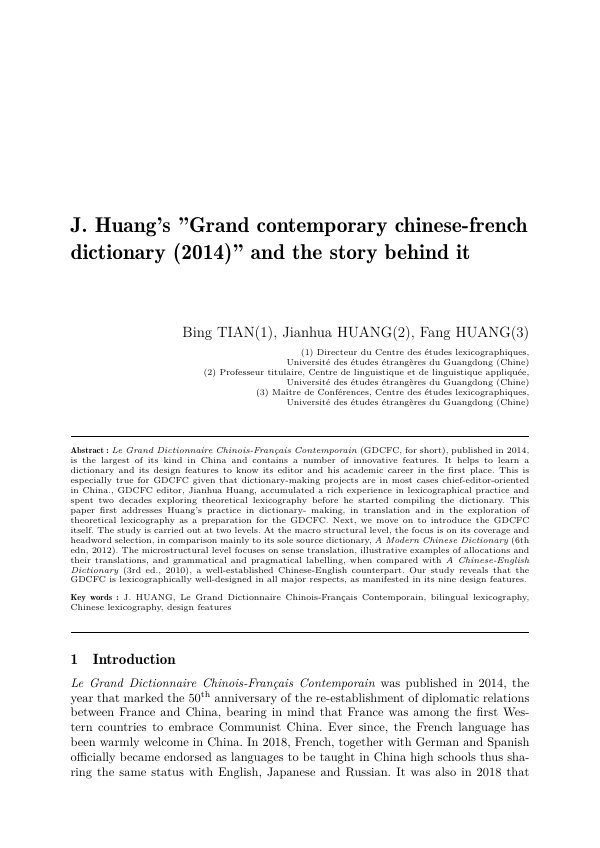
Le Grand Dictionnaire Chinois-Français Contemporain (GDCFC, for short), published in 2014, is the largest of its kind in China and contains a number of innovative features. It helps to learn a dictionary and its design features to know its editor and his academic career in the first place. This is especially true for GDCFC given that dictionary-making projects are in most cases chief-editor-oriented in China., GDCFC editor, Jianhua Huang, accumulated a rich experience in lexicographical practice and spent two decades exploring theoretical lexicography before he started compiling the dictionary. This paper first addresses Huang’s practice in dictionary- making, in translation and in the exploration of theoretical lexicography as a preparation for the GDCFC. Next, we move on to introduce the GDCFC itself. The study is carried out at two levels. At the macro structural level, the focus is on its coverage and headword selection, in comparison mainly to its sole source dictionary, A Modern Chinese Dictionary (6th edn, 2012). The microstructural level focuses on sense translation, illustrative examples of allocations and their translations, and grammatical and pragmatical labelling, when compared with A Chinese-English Dictionary (3rd ed., 2010), a well-established Chinese-English counterpart. Our study reveals that the GDCFC is lexicographically well-designed in all major respects, as manifested in its nine design features.
Lire le chapitre
PDF de 17 pages, tel qu’imprimé dans l’ouvrage, pages 103 à 119. En libre accès.
Pas encore de consultation enregistrée.