Monitoring of ultrarapid flux fluctuations in galactic sources of water-vapour maser emission at a wavelength of 1.35 cm
Résumé
Results of a search for ultrarapid flux fluctuations of galactic sources of maser emission in the water-vapour line at a wavelength of 1.35~cm. An observational technique of a search for ultrarapid flux fluctuations has been developed. From 2002 to 2008 a number of observational sessions for about 30 maser sources have been carried out. Several of them have demonstrated such a variability. Possible mechanisms of the variability are discussed, among them internal processes within the sources themselves as well as external ones, including the theoretical possibility of a resonant effect of gravitational waves from galactic objects on the masering region. Clear evidence for the presence of such a variability has been found in several sources (Cep~A, W43M3, W49N, W33B). This variability appears not§permanently, but only certain states of particular H2O masers. Of major interest is the behaviour of Cep~A in some observational sessions: this source can turn from the state of relative stability to the state of variability as strong as tens per cent in some features on timescales of tens of minutes. For the Russian authors this work was supported by the Russian Foundation for Basic Research (project codes 06-02-16806 and 08-02-01179).
Abstract
Results of a search for ultrarapid flux fluctuations of galactic sources of maser emission in the water-vapour line at a wavelength of 1.35~cm. An observational technique of a search for ultrarapid flux fluctuations has been developed. From 2002 to 2008 a number of observational sessions for about 30 maser sources have been carried out. Several of them have demonstrated such a variability. Possible mechanisms of the variability are discussed, among them internal processes within the sources themselves as well as external ones, including the theoretical possibility of a resonant effect of gravitational waves from galactic objects on the masering region. Clear evidence for the presence of such a variability has been found in several sources (Cep~A, W43M3, W49N, W33B). This variability appears not§permanently, but only certain states of particular H2O masers. Of major interest is the behaviour of Cep~A in some observational sessions: this source can turn from the state of relative stability to the state of variability as strong as tens per cent in some features on timescales of tens of minutes. For the Russian authors this work was supported by the Russian Foundation for Basic Research (project codes 06-02-16806 and 08-02-01179).
Lire l’article
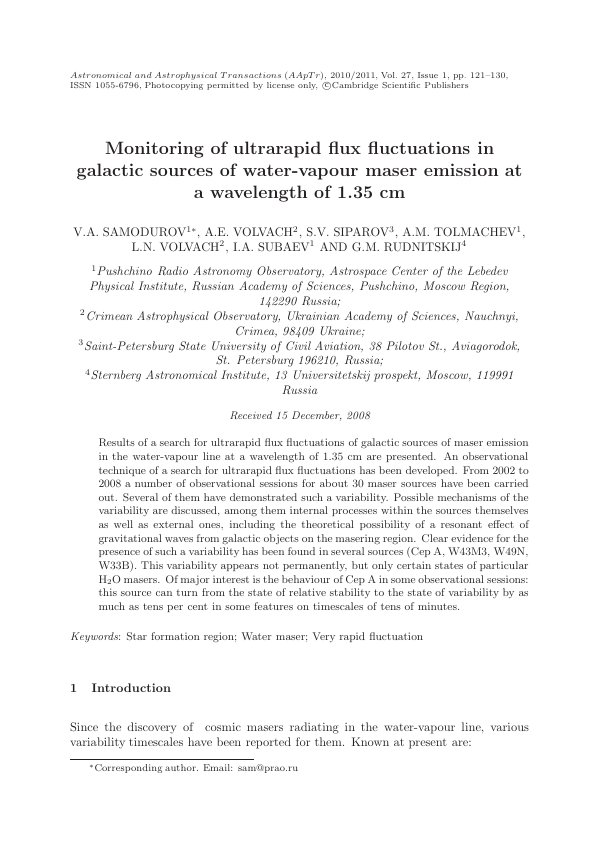
PDF de 10 pages, tel qu’imprimé dans la revue, pages 121 à 130. En libre accès.
Pas encore de consultation enregistrée.