When Interpreters Encounter Academics
Résumé
En 2010, le master en interprétation de conférence à l’Université de Nairobi (UoN) est mis en place comme programme pilote dans le cadre du Consortium panafricain pour un master en interprétation et en traduction (PAMCIT). Pendant les premières années (2010-2013), le programme s’est appuyé fortement sur l’assistance pédagogique offerte par des institutions basées dans le Nord. Dans ce chapitre, nous analysons la contribution de la coopération nord-sud aux cursus d’interprétation à l’Université de Nairobi. Pour ce faire, nous abordons la formation d’interprètes comme un phénomène situé à l’interface de deux champs professionnels, l’interprétation et le monde académique, et analysons les défis que présente, dans ce contexte, la conversion du capital symbolique propre à chaque champ. Les réflexions dans ce chapitre visent ainsi à illustrer qu’il est important d’inclure des acteurs du domaine académique et des interprètes professionnels dans les programmes de formation établis au sein des universités africaines.
Abstract
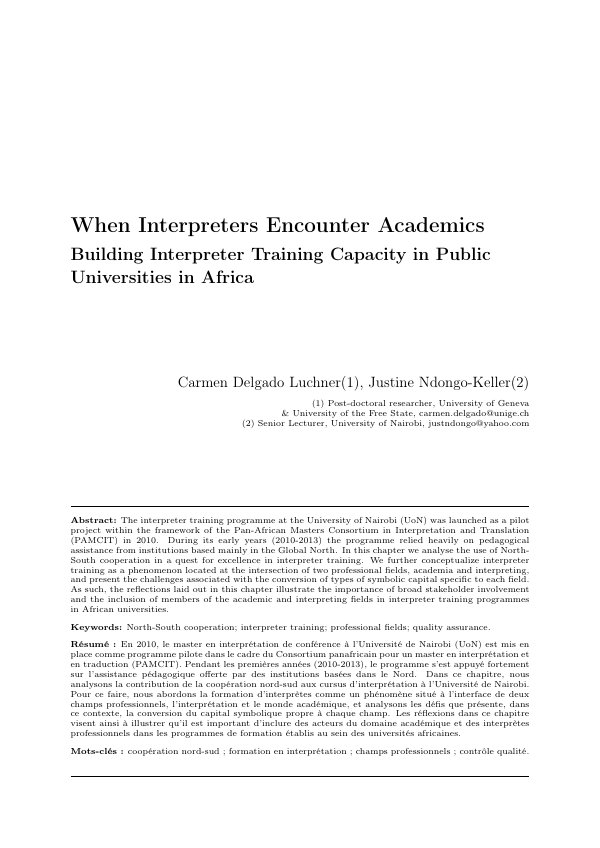
The interpreter training programme at the University of Nairobi (UoN) was launched as a pilot project within the framework of the Pan-African Masters Consortium in Interpretation and Translation (PAMCIT) in 2010. During its early years (2010-2013) the programme relied heavily on pedagogical assistance from institutions based mainly in the Global North. In this chapter we analyse the use of North-South cooperation in a quest for excellence in interpreter training. We further conceptualize interpreter training as a phenomenon located at the intersection of two professional fields, academia and interpreting, and present the challenges associated with the conversion of types of symbolic capital specific to each field. As such, the reflections laid out in this chapter illustrate the importance of broad stakeholder involvement and the inclusion of members of the academic and interpreting fields in interpreter training programmes in African universities.
Lire le chapitre
PDF de 14 pages, tel qu’imprimé dans l’ouvrage, pages 39 à 52. En libre accès.
Pas encore de consultation enregistrée.