Mechanisms for Translation of Telephone Calls for Inter-Language Communication and the Development of National Languages and Cultures in Cameroon
Résumé
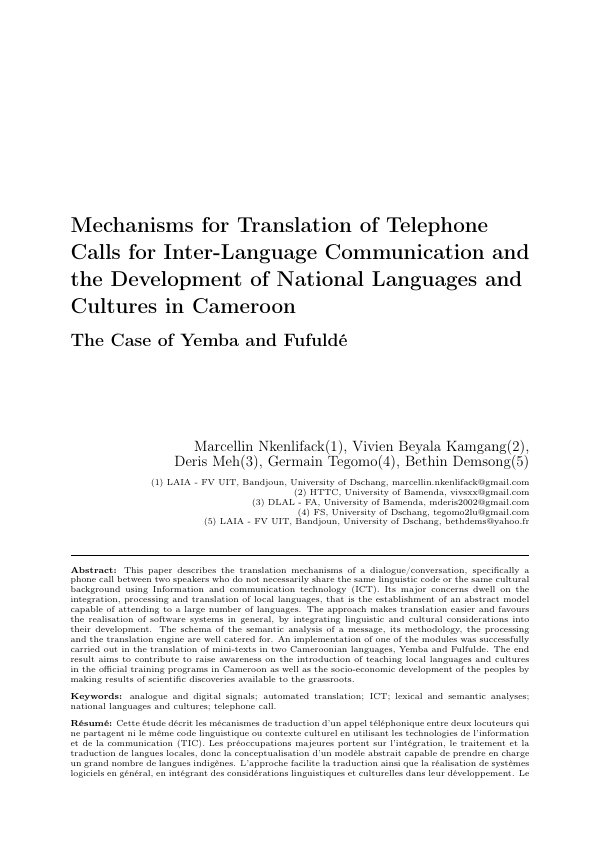
This paper describes the translation mechanisms of a dialogue/conversation, specifically a phone call between two speakers who do not necessarily share the same linguistic code or the same cultural background using Information and communication technology (ICT). Its major concerns dwell on the integration, processing and translation of local languages, that is the establishment of an abstract model capable of attending to a large number of languages. The approach makes translation easier and favours the realisation of software systems in general, by integrating linguistic and cultural considerations into their development. The schema of the semantic analysis of a message, its methodology, the processing and the translation engine are well catered for. An implementation of one of the modules was successfully carried out in the translation of mini-texts in two Cameroonian languages, Yemba and Fulfulde. The end result aims to contribute to raise awareness on the introduction of teaching local languages and cultures in the official training programs in Cameroon as well as the socio-economic development of the peoples by making results of scientific discoveries available to the grassroots.
Abstract
Cette étude décrit les mécanismes de traduction d’un appel téléphonique entre deux locuteurs qui ne partagent ni le même code linguistique ou contexte culturel en utilisant les technologies de l’information et de la communication (TIC). Les préoccupations majeures portent sur l’intégration, le traitement et la traduction de langues locales, donc la conceptualisation d’un modèle abstrait capable de prendre en charge un grand nombre de langues indigènes. L’approche facilite la traduction ainsi que la réalisation de systèmes logiciels en général, en intégrant des considérations linguistiques et culturelles dans leur développement. Le schéma d’analyse sémantique d’un message, sa méthodologie, le traitement et le moteur de traduction sont bien pris en compte. Une implémentation d’un des modules a été réalisée avec succès s’agissant de traduire des mini-textes dans deux langues camerounaises, le yemba et le foulfouldé. L’objectif est d’accroitre la sensibilisation à l’enseignement de langues et cultures dans les programmes de formation officiels au Cameroun ainsi qu’au développement socio-économique des personnes en mettant à profit les découvertes scientifiques auprès des populations locales.
Lire le chapitre
PDF de 17 pages, tel qu’imprimé dans l’ouvrage, pages 197 à 214. En libre accès.
Pas encore de consultation enregistrée.