Impact of Dual Specialisation on Students’ Competence
Résumé
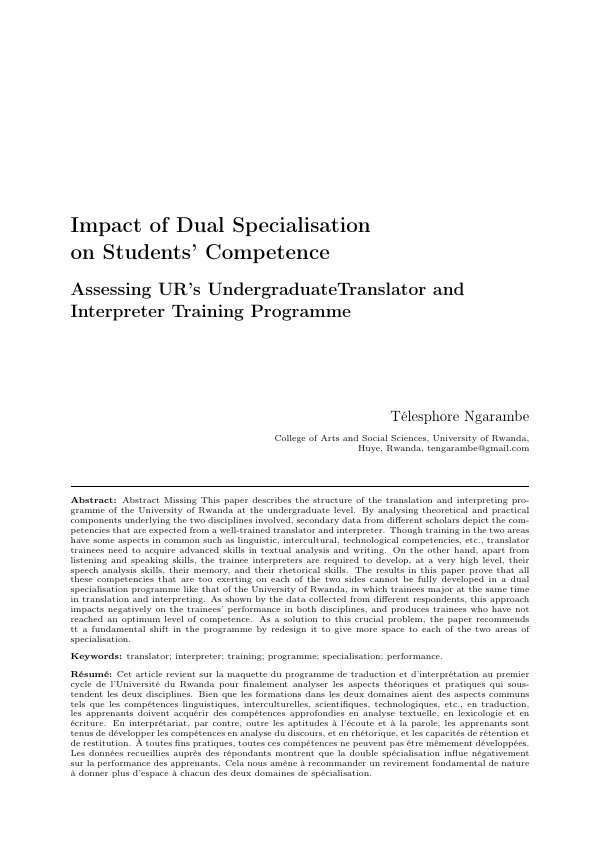
This paper describes the structure of the translation and interpreting programme of the University of Rwanda at the undergraduate level. By analysing theoretical and practical components underlying the two disciplines involved, secondary data from different scholars depict the competencies that are expected from a well-trained translator and interpreter. Though training in the two areas have some aspects in common such as linguistic, intercultural, technological competencies, etc., translator trainees need to acquire advanced skills in textual analysis and writing. On the other hand, apart from listening and speaking skills, the trainee interpreters are required to develop, at a very high level, their speech analysis skills, their memory, and their rhetorical skills. The results in this paper prove that all these competencies that are too exerting on each of the two sides cannot be fully developed in a dual specialisation programme like that of the University of Rwanda, in which trainees major at the same time in translation and interpreting. As shown by the data collected from different respondents, this approach impacts negatively on the trainees’ performance in both disciplines, and produces – trainees who have not reached an optimum level of competence. As a solution to this crucial problem, the paper recommends tt a fundamental shift in the programme by redesign it to give more space to each of the two areas of specialisation.
Abstract
Cet article revient sur la maquette du programme de traduction et d’interprétation au premier cycle de l’Université du Rwanda pour finalement analyser les aspects théoriques et pratiques qui sous-tendent les deux disciplines. Bien que les formations dans les deux domaines aient des aspects communs tels que les compétences linguistiques, interculturelles, scientifiques, technologiques, etc., en traduction, les apprenants doivent acquérir des compétences approfondies en analyse textuelle, en lexicologie et en écriture. En interprétariat, par contre, outre les aptitudes à l’écoute et à la parole, les apprenants sont tenus de développer les compétences en analyse du discours, et en rhétorique, et les capacités de rétention et de restitution. À toutes fins pratiques, toutes ces compétences ne peuvent pas être mêmement développées.
Les données recueillies auprès des répondants montrent que la double spécialisation influe négativement sur la performance des apprenants. Cela nous amène à recommander un revirement fondamental de nature à donner plus d’espace à chacun des deux domaines de spécialisation.
Lire le chapitre
PDF de 20 pages, tel qu’imprimé dans l’ouvrage, pages 177 à 196. En libre accès.
Pas encore de consultation enregistrée.