La contribution des interprètes africains à l’administration de la justice internationale
Résumé
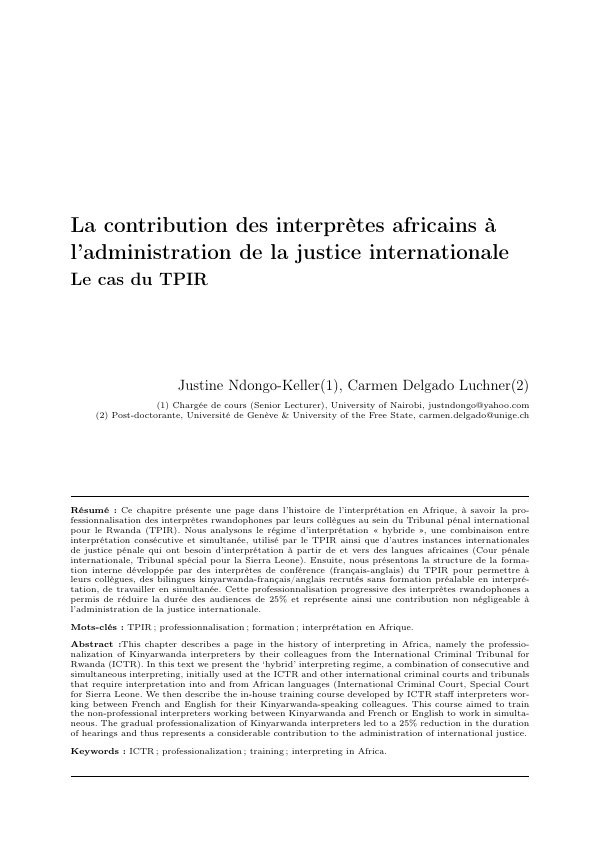
Ce chapitre présente une page dans l’histoire de l’interprétation en Afrique, à savoir la professionnalisation des interprètes rwandophones par leurs collègues au sein du Tribunal pénal international pour le Rwanda (TPIR). Nous analysons le régime d’interprétation « hybride », une combinaison entre interprétation consécutive et simultanée, utilisé par le TPIR ainsi que d’autres instances internationales de justice pénale qui ont besoin d’interprétation à partir de et vers des langues africaines (Cour pénale internationale, Tribunal spécial pour la Sierra Leone). Ensuite, nous présentons la structure de la formation interne développée par des interprètes de conférence (français-anglais) du TPIR pour permettre à leurs collègues, des bilingues kinyarwanda-français/anglais recrutés sans formation préalable en interprétation, de travailler en simultanée. Cette professionnalisation progressive des interprètes rwandophones a permis de réduire la durée des audiences de 25 % et représente ainsi une contribution non négligeable à l’administration de la justice internationale.
Abstract
This chapter describes a page in the history of interpreting in Africa, namely the professionalization of Kinyarwanda interpreters by their colleagues from the International Criminal Tribunal for Rwanda (ICTR). In this text we present the ‘hybrid’ interpreting regime, a combination of consecutive and simultaneous interpreting, initially used at the ICTR and other international criminal courts and tribunals that require interpretation into and from African languages (International Criminal Court, Special Court for Sierra Leone. We then describe the in-house training course developed by ICTR staff interpreters working between French and English for their Kinyarwanda-speaking colleagues. This course aimed to train the non-professional interpreters working between Kinyarwanda and French or English to work in simultaneous. The gradual professionalization of Kinyarwanda interpreters led to a 25% reduction in the duration of hearings and thus represents a considerable contribution to the administration of international justice.
Lire le chapitre
PDF de 16 pages, tel qu’imprimé dans l’ouvrage, pages 161 à 176. En libre accès.
Pas encore de consultation enregistrée.