L’importance de la traduction en langues nationales pour l’essor de l’éducation multilingue au Cameroun
Résumé
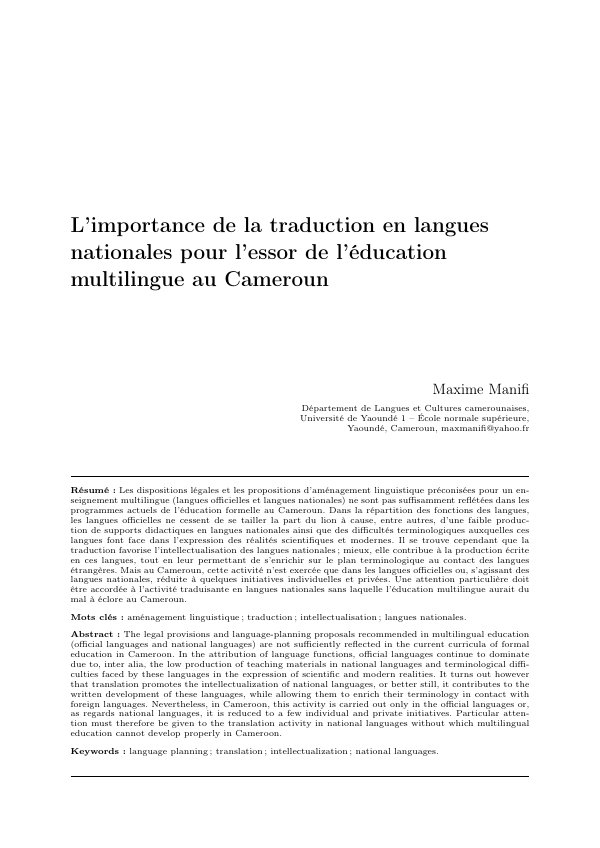
Les dispositions légales et les propositions d’aménagement linguistique préconisées pour un enseignement multilingue (langues officielles et langues nationales) ne sont pas suffisamment reflétées dans les programmes actuels de l’éducation formelle au Cameroun. Dans la répartition des fonctions des langues, les langues officielles ne cessent de se tailler la part du lion à cause, entre autres, d’une faible production de supports didactiques en langues nationales ainsi que des difficultés terminologiques auxquelles ces langues font face dans l’expression des réalités scientifiques et modernes. Il se trouve cependant que la traduction favorise l’intellectualisation des langues nationales ; mieux, elle contribue à la production écrite en ces langues, tout en leur permettant de s’enrichir sur le plan terminologique au contact des langues étrangères. Mais au Cameroun, cette activité n’est exercée que dans les langues officielles ou, s’agissant des langues nationales, réduite à quelques initiatives individuelles et privées. Une attention particulière doit être accordée à l’activité traduisante en langues nationales sans laquelle l’éducation multilingue aurait du mal à éclore au Cameroun.
Abstract
The legal provisions and language-planning proposals recommended in multilingual education (official languages and national languages) are not sufficiently reflected in the current curricula of formal education in Cameroon. In the attribution of language functions, official languages continue to dominate due to, inter alia, the low production of teaching materials in national languages and terminological difficulties faced by these languages in the expression of scientific and modern realities. It turns out however that translation promotes the intellectualization of national languages, or better still, it contributes to the written development of these languages, while allowing them to enrich their terminology in contact with foreign languages. Nevertheless, in Cameroon, this activity is carried out only in the official languages or, as regards national languages, it is reduced to a few individual and private initiatives. Particular attention must therefore be given to the translation activity in national languages without which multilingual education cannot develop properly in Cameroon
Lire le chapitre
PDF de 15 pages, tel qu’imprimé dans l’ouvrage, pages 125 à 140. En libre accès.
Pas encore de consultation enregistrée.