Time variations of the total unsigned magnetic flux of active regions during the solar cycle 24
Abstract
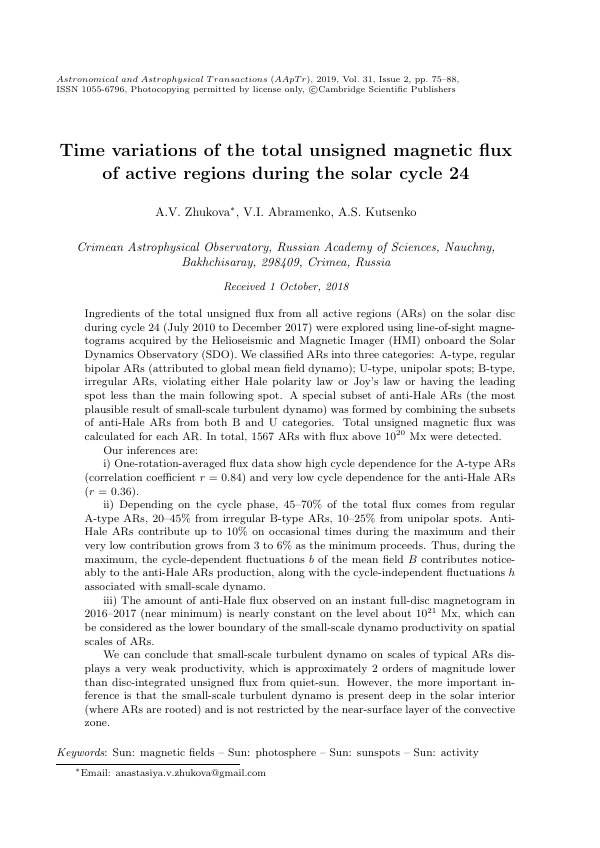
Ingredients of the total unsigned flux from all active regions (ARs) on the solar disc during cycle 24 (July 2010 to December 2017) were explored using line-of-sight magnetograms acquired by the Helioseismic and Magnetic Imager (HMI) onboard the Solar Dynamics Observatory (SDO). We classified ARs into three categories: A-type, regular bipolar ARs (attributed to global mean field dynamo); U-type, unipolar spots; B-type, irregular ARs, violating either Hale polarity law or Joy's law or having the leading spot less than the main following spot. A special subset of anti-Hale ARs (the most plausible result of small-scale turbulent dynamo) was formed by combining the subsets of anti-Hale ARs from both B and U categories. Total unsigned magnetic flux was calculated for each AR. In total, 1567 ARs with flux above 10<sup>20</sup> Mx were detected.
Our inferences are:
i) One-rotation-averaged flux data show high cycle dependence for the A-type ARs (correlation coeffcient r = 0.84) and very low cycle dependence for the anti-Hale ARs (r = 0.36).
ii) Depending on the cycle phase, 45-70% of the total flux comes from regular A-type ARs, 20-45% from irregular B-type ARs, 10-25% from unipolar spots. Anti-Hale ARs contribute up to 10% on occasional times during the maximum and their very low contribution grows from 3 to 6% as the minimum proceeds. Thus, during the maximum, the cycle-dependent fluctuations b of the mean field B contributes noticeably to the anti-Hale ARs production, along with the cycle-independent fuctuations h associated with small-scale dynamo.
iii) The amount of anti-Hale flux observed on an instant full-disc magnetogram in 2016-2017 (near minimum) is nearly constant on the level about 10<sup>21</sup> Mx, which can be considered as the lower boundary of the small-scale dynamo productivity on spatial scales of ARs.
We can conclude that small-scale turbulent dynamo on scales of typical ARs displays a very weak productivity, which is approximately 2 orders of magnitude lower than disc-integrated unsigned flux from quiet-sun. However, the more important inference is that the small-scale turbulent dynamo is present deep in the solar interior (where ARs are rooted) and is not restricted by the near-surface layer of the convective zone.
Lire l’article
PDF de 14 pages, tel qu’imprimé dans la revue, pages 75 à 88. En libre accès.
Pas encore de consultation enregistrée.