Apport de données de HRV de Spot pour l'étude des variations phénologiques dans le bassin de l'Ouémé (Bénin)
Résumé
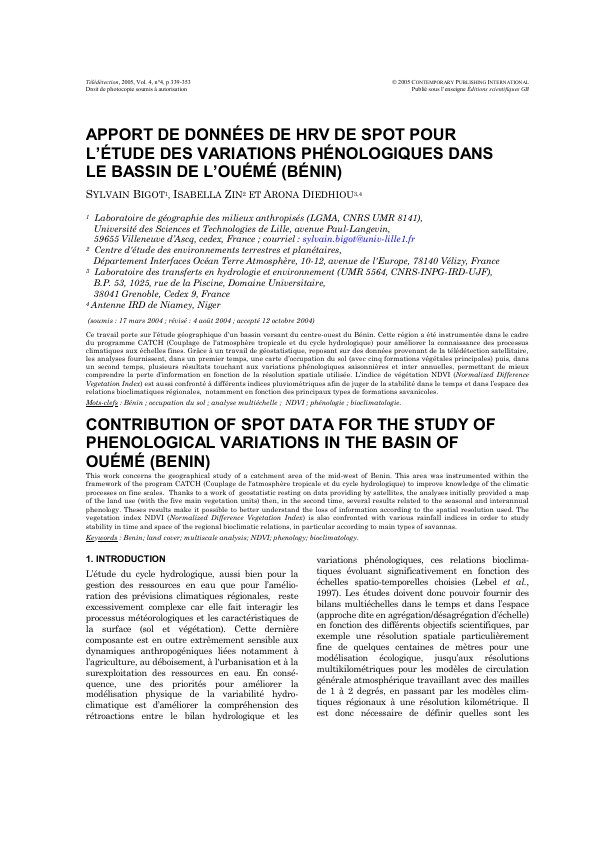
Ce travail porte sur l’étude géographique d’un bassin versant du centre-ouest du Bénin. Cette région a été instrumentée dans le cadre du programme CATCH (Couplage de l'atmosphère tropicale et du cycle hydrologique) pour améliorer la connaissance des processus climatiques aux échelles fines. Grâce à un travail de géostatistique, reposant sur des données provenant de la télédétection satellitaire, les analyses fournissent, dans un premier temps, une carte d’occupation du sol (avec cinq formations végétales principales) puis, dans un second temps, plusieurs résultats touchant aux variations phénologiques saisonnières et inter annuelles, permettant de mieux comprendre la perte d’information en fonction de la résolution spatiale utilisée. L’indice de végétation NDVI (Normalized Difference Vegetation Index) est aussi confronté à différents indices pluviométriques afin de juger de la stabilité dans le temps et dans l’espace des relations bioclimatiques régionales, notamment en fonction des principaux types de formations savanicoles.
Abstract
This work concerns the geographical study of a catchment area of the mid-west of Benin. This area was instrumented within the framework of the program CATCH (Couplage de l'atmosphère tropicale et du cycle hydrologique) to improve knowledge of the climatic processes on fine scales. Thanks to a work of geostatistic resting on data providing by satellites, the analyses initially provided a map of the land use (with the five main vegetation units) then, in the second time, several results related to the seasonal and interannual phenology. Theses results make it possible to better understand the loss of information according to the spatial resolution used. The vegetation index NDVI (Normalized Difference Vegetation Index) is also confronted with various rainfall indices in order to study stability in time and space of the regional bioclimatic relations, in particular according to main types of savannas.
Lire l’article
PDF de 8 pages, tel qu’imprimé dans la revue, pages 339 à 353. En libre accès.
Pas encore de consultation enregistrée.