Analyse des effets atmosphériques sur les indices de végétation en milieu marin
Résumé
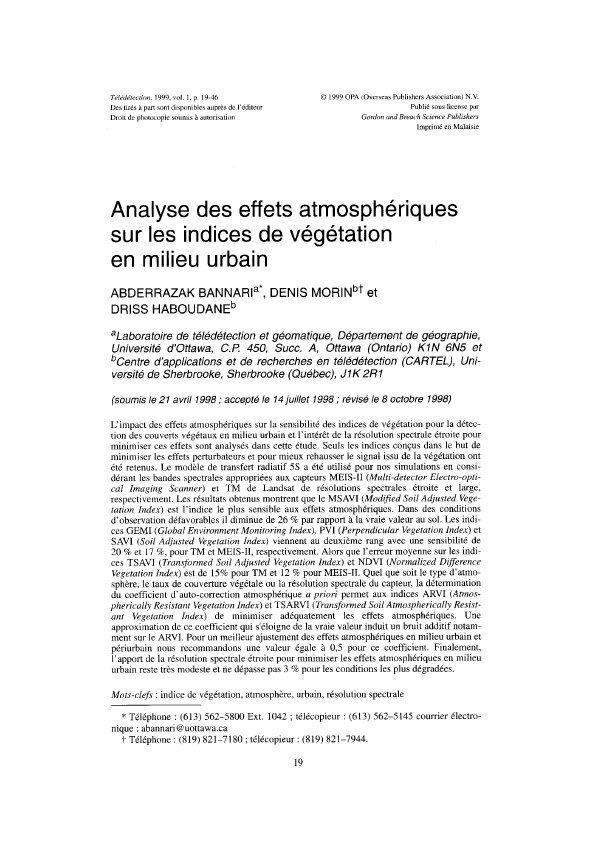
L'impact des effets atmosphériques sur la sensibilité des indices de végétation pour la détection des couverts végétaux en milieu urbain et l'intérêt de la résolution spectrale étroite pour minimiser ces effets sont analysés dans cette étude. Seuls les indices conçus dans le but de minimiser les effets perturbateurs et pour mieux rehausser le signal issu de la végétation ont été retenus. Le modèle de transfert radiatif 5S a été utilisé pour nos simulations en considérant les bandes spectrales appropriées aux capteurs MEIS-II (Multi-detector Electro-optical Imaging Scanner) et TM de Landsat de résolutions spectrales étroite et large, respectivement. Les résultats obtenus montrent que le MSAVI (Modified Soil Adjusted Vegetation Index) est l'indice le plus sensible aux effets atmosphériques. Dans des conditions d'observation défavorables il diminue de 26 % par rapport à la vraie valeur au sol. Les indices GEMI (Global Environment Monitoring Index), PVI (Perpendicular Vegetation Index) et SAVI (Soil Adjusted Vegetation Index) viennent au deuxième rang avec une sensibilité de 20 % et 17 %, pour TM et MEIS-II , respectivement. Alors que l'erreur moyenne sur les indices TSAVI (Transformed Soil Adjusted Vegetation Index) et NDVI (Normalized Dfference Vegetation Index) est de 15% pour TM et 12 % pour MEIS-II .Quel que soit le type d'atmosphère, le taux de couverture végétale ou la résolution spectrale du capteur, la détermination du coefficient d'auto-correction atmosphérique a priori permet aux indices ARVI (Atmospherically Resistant Vegetation Index) et TSARVI (Transformed Soil Atmospherically Resistant Vegetation Index) de minimiser adéquatement les effets atmosphériques. Une approximation de ce coefficient qui s'éloigne de la vraie valeur induit un bruit additif notamment sur le ARVI. Pour un meilleur ajustement des effets atmosphériques en milieu urbain et périurbain nous recommandons une valeur égale à 0,5 pour ce coefficient. Finalement, l'apport de la résolution spectrale étroite pour minimiser les effets atmosphériques en milieu urbain reste très modeste et ne dépasse pas 3 % pour les conditions les plus dégradées.
Abstract
This study analyses the impact of atmospheric effects on the sensitivity of vegetation indices for sensing urban vegetation cover and the use of narrow spectral resolution to minimize such effects. We considered only indices designed to minimize upsetting effects and increase the signal received from vegetation.The 5S atmospheric code was used for our simulations, taking into account the spectral bands applicable to the MEIS-II (Multi-detector Electro-optical imaging Scanner) and TM sensors, with narrow and broad spectral resolutions, respectively. The results obtained show that the Modified Soil Adjusted Vegetation Index (,MSAVI) is the most sensitive index to atmospheric effects; in bad sensing conditions, it decreases by 26 % compared to the true ground value. The Global Environment Monitoring Index (GEMI), the Perpendicular Vegetation Index (PVI) and the Soil Adjusted Vegetation Index (SAVI) came in second with 20 % and 17 % sensitivity for TM and MEIS-II respectively, while the average error on the Transformed Soil Adjusted Vegetation Index (TSAVI) and the Normalized Difference Vegetation Index (NDVI) is 15 % for TM and 12 % for MEIS-II . Whatever type of atmosphere, vegetation cover or spectral resolution of the sensor, establishing first the atmospheric self-correction factor allows the Atmospherically Resistant Vegetation Index (ARVI) and Transformed Soil Atmospherically Resistant Vegetation Index (TSARVI) to adequately eliminate atmospheric effects. An approximation of this factor insufficiently close to the real value introduces additional noise, particularly on the ARVI. To better correct the atmospheric effects in a urban or urban-fringe environment, we recommend a factor of 0.5. Finally, the contribution of narrow spectral resolution to minimizing the atmospheric effects in an urban environment is very low and does not exceed 3 % in the worst conditions.
Lire l’article
PDF de 28 pages, tel qu’imprimé dans la revue, pages 19 à 46. En libre accès.
Pas encore de consultation enregistrée.