Governing science–industry relations in the South
Abstract
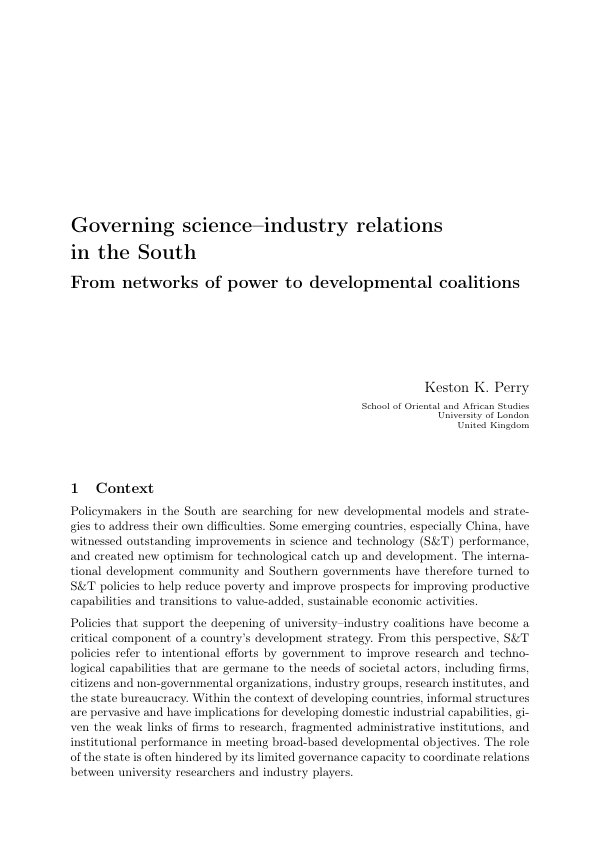
**Context**: Policymakers in the South are searching for new developmental models and strategies to address their own difficulties. Some emerging countries, especially China, have witnessed outstanding improvements in science and technology (S&T) performance, and created new optimism for technological catch up and development. The international development community and Southern governments have therefore turned to S\&T policies to help reduce poverty and improve prospects for improving productive capabilities and transitions to value-added, sustainable economic activities.
Policies that support the deepening of university--industry coalitions have become a critical component of a country's development strategy. From this perspective, S&T policies refer to intentional efforts by government to improve research and technological capabilities that are germane to the needs of societal actors, including firms, citizens and non-governmental organizations, industry groups, research institutes, and the state bureaucracy. Within the context of developing countries, informal structures are pervasive and have implications for developing domestic industrial capabilities, given the weak links of firms to research, fragmented administrative institutions, and institutional performance in meeting broad-based developmental objectives. The role of the state is often hindered by its limited governance capacity to coordinate relations between university researchers and industry players.
**Searching for an S&T development model** --- Latin American scholars have increasingly sought to explain the widespread underperformance of S&T institutions in the region. Based on the innovation systems approach, they outline missing links or systemic failures to the effective design and implementation of S&T policies as a common feature in the poor performance of these countries. Innovation systems scholars often gloss over the critical role of politics in shaping outcomes and implementation of S&T policy. Transformation based on S&T investment depends on a number of variables, links, and processes that spur an indigenous process of capitalist transformation.
**Networks of power and coalitions in developing countries** --- Relations among the scientific community, industrial sectors, and governance apparatus are structured by impersonal bureaucratic structures and informal channels. Relations are also shaped by the distribution of power and technical capabilities across different economic, bureaucratic, and political organizations. These observations reflect the political nature of S&T governance, and recognize that the nature of such interactions influence the process of learning and innovation.
In the STI domain, the actors and institutions in the network exercise varying levels of influence. The distribution of power can help to explain, for example, the influence of the business sector on STI policies, the capacity of industry associations to gather information and generate knowledge, the susceptibility of public-funded universities to policy or political struggles, or whether industrial research programs are subject to patronage and bargaining.
The state can use its power to design and implement policies that foster collective action and developmental coalitions to address productivity constraints and social development goals. The emergence of coalitions in various settings can result from deliberate efforts made in policy or from serendipitous reactions from informal networks. They respond to specific institutional, technological, and economic forces and triggers that prevail in a society to address particular problems.
Lire le chapitre
PDF de 4 pages, tel qu’imprimé dans l’ouvrage, pages 93 à 96. En libre accès.
Pas encore de consultation enregistrée.