Study of ionospheric TEC variability over low, mid and high latitudes during solar maximum and its comparison with IRI-2012 and IRI-2016 model
Résumé
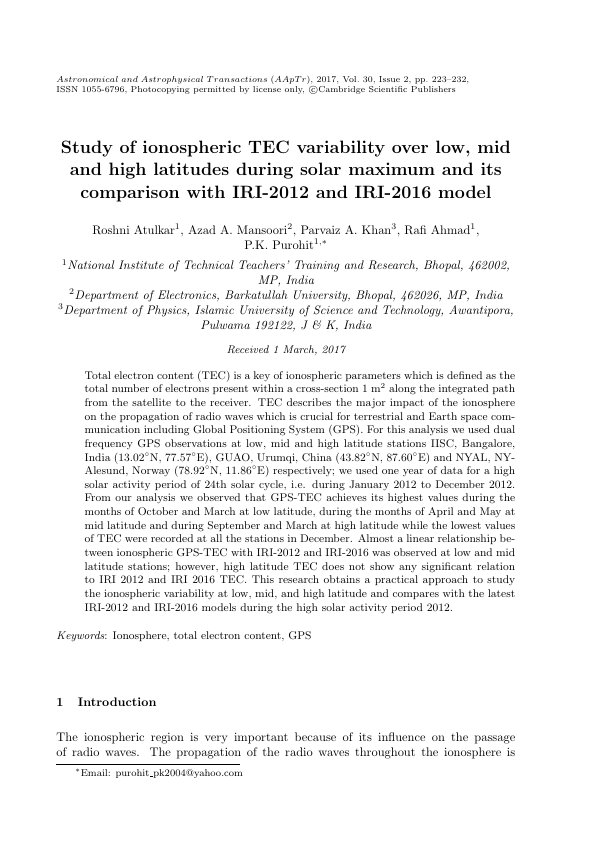
Total electron content (TEC) is a key of ionospheric parameters which is defined as the total number of electrons present within a cross-section 1 m² along the integrated path from the satellite to the receiver. TEC describes the major impact of the ionosphere on the propagation of radio waves which is crucial for terrestrial and Earth space communication including Global Positioning System (GPS). For this analysis we used dual frequency GPS observations at low, mid and high latitude stations IISC, Bangalore,India (13.02°N, 77.57°E), GUAO, Urumqi, China (43.82°N, 87.60°E) and NYAL, NY-
Alesund, Norway (78.92°N, 11.86 °E) respectively; we used one year of data for a high solar activity period of 24th solar cycle, i.e. during January 2012 to December 2012. From our analysis we observed that GPS-TEC achieves its highest values during the months of October and March at low latitude, during the months of April and May at mid latitude and during September and March at high latitude while the lowest values of TEC were recorded at all the stations in December. Almost a linear relationship between ionospheric GPS-TEC with IRI-2012 and IRI-2016 was observed at low and mid latitude stations; however, high latitude TEC does not show any significant relation to IRI 2012 and IRI 2016 TEC. This research obtains a practical approach to study the ionospheric variability at low, mid, and high latitude and compares with the latest IRI-2012 and IRI-2016 models during the high solar activity period 2012.
Abstract
Total electron content (TEC) is a key of ionospheric parameters which is defined as the total number of electrons present within a cross-section 1 m² along the integrated path from the satellite to the receiver. TEC describes the major impact of the ionosphere on the propagation of radio waves which is crucial for terrestrial and Earth space communication including Global Positioning System (GPS). For this analysis we used dual frequency GPS observations at low, mid and high latitude stations IISC, Bangalore,India (13.02°N, 77.57°E), GUAO, Urumqi, China (43.82°N, 87.60°E) and NYAL, NY-
Alesund, Norway (78.92°N, 11.86 °E) respectively; we used one year of data for a high solar activity period of 24th solar cycle, i.e. during January 2012 to December 2012. From our analysis we observed that GPS-TEC achieves its highest values during the months of October and March at low latitude, during the months of April and May at mid latitude and during September and March at high latitude while the lowest values of TEC were recorded at all the stations in December. Almost a linear relationship between ionospheric GPS-TEC with IRI-2012 and IRI-2016 was observed at low and mid latitude stations; however, high latitude TEC does not show any significant relation to IRI 2012 and IRI 2016 TEC. This research obtains a practical approach to study the ionospheric variability at low, mid, and high latitude and compares with the latest IRI-2012 and IRI-2016 models during the high solar activity period 2012.
Lire l’article
PDF de 10 pages, tel qu’imprimé dans la revue, pages 223 à 232. En libre accès.
Pas encore de consultation enregistrée.