The saturation state of H<sub>2</sub>O masers in star forming regions
Résumé
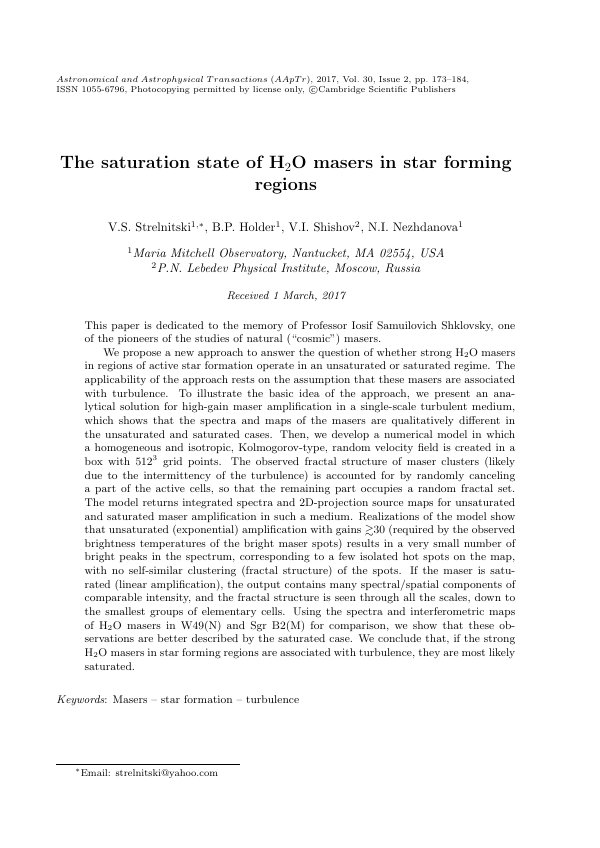
This paper is dedicated to the memory of Professor Iosif Samuilovich Shklovsky, one of the pioneers of the studies of natural ("cosmic") masers. We propose a new approach to answer the question of whether strong H<sub>2</sub>O masers in regions of active star formation operate in an unsaturated or saturated regime. The applicability of the approach rests on the assumption that these masers are associated with turbulence. To illustrate the basic idea of the approach, we present an analytical solution for high-gain maser amplification in a single-scale turbulent medium, which shows that the spectra and maps of the masers are qualitatively different in the unsaturated and saturated cases. Then, we develop a numerical model in which a homogeneous and isotropic, Kolmogorov-type, random velocity field is created in a box with 512<sup>3</sup> grid points. The observed fractal structure of maser clusters (likely due to the intermittency of the turbulence) is accounted for by randomly canceling a part of the active cells, so that the remaining part occupies a random fractal set. The model returns integrated spectra and 2D-projection source maps for unsaturated and saturated maser amplification in such a medium. Realizations of the model show that unsaturated (exponential) amplification with gains = 30 (required by the observed brightness temperatures of the bright maser spots) results in a very small number of bright peaks in the spectrum, corresponding to a few isolated hot spots on the map, with no self-similar clustering (fractal structure) of the spots. If the maser is saturated (linear amplification), the output contains many spectral/spatial components of comparable intensity, and the fractal structure is seen through all the scales, down to the smallest groups of elementary cells. Using the spectra and interferometric maps of H<sub>2</sub>O masers in W49(N) and Sgr B2(M) for comparison, we show that these observations are better described by the saturated case. We conclude that, if the strong H<sub>2</sub>O masers in star forming regions are associated with turbulence, they are most likely saturated.
Abstract
This paper is dedicated to the memory of Professor Iosif Samuilovich Shklovsky, one of the pioneers of the studies of natural ("cosmic") masers. We propose a new approach to answer the question of whether strong H<sub>2</sub>O masers in regions of active star formation operate in an unsaturated or saturated regime. The applicability of the approach rests on the assumption that these masers are associated with turbulence. To illustrate the basic idea of the approach, we present an analytical solution for high-gain maser amplification in a single-scale turbulent medium, which shows that the spectra and maps of the masers are qualitatively different in the unsaturated and saturated cases. Then, we develop a numerical model in which a homogeneous and isotropic, Kolmogorov-type, random velocity field is created in a box with 512<sup>3</sup> grid points. The observed fractal structure of maser clusters (likely due to the intermittency of the turbulence) is accounted for by randomly canceling a part of the active cells, so that the remaining part occupies a random fractal set. The model returns integrated spectra and 2D-projection source maps for unsaturated and saturated maser amplification in such a medium. Realizations of the model show that unsaturated (exponential) amplification with gains = 30 (required by the observed brightness temperatures of the bright maser spots) results in a very small number of bright peaks in the spectrum, corresponding to a few isolated hot spots on the map, with no self-similar clustering (fractal structure) of the spots. If the maser is saturated (linear amplification), the output contains many spectral/spatial components of comparable intensity, and the fractal structure is seen through all the scales, down to the smallest groups of elementary cells. Using the spectra and interferometric maps of H<sub>2</sub>O masers in W49(N) and Sgr B2(M) for comparison, we show that these observations are better described by the saturated case. We conclude that, if the strong H<sub>2</sub>O masers in star forming regions are associated with turbulence, they are most likely saturated.
Lire l’article
PDF de 12 pages, tel qu’imprimé dans la revue, pages 173 à 184. En libre accès.
Pas encore de consultation enregistrée.