What we recently learnt about Crab: structure of the wind, the shock, flares and reconnection
Résumé
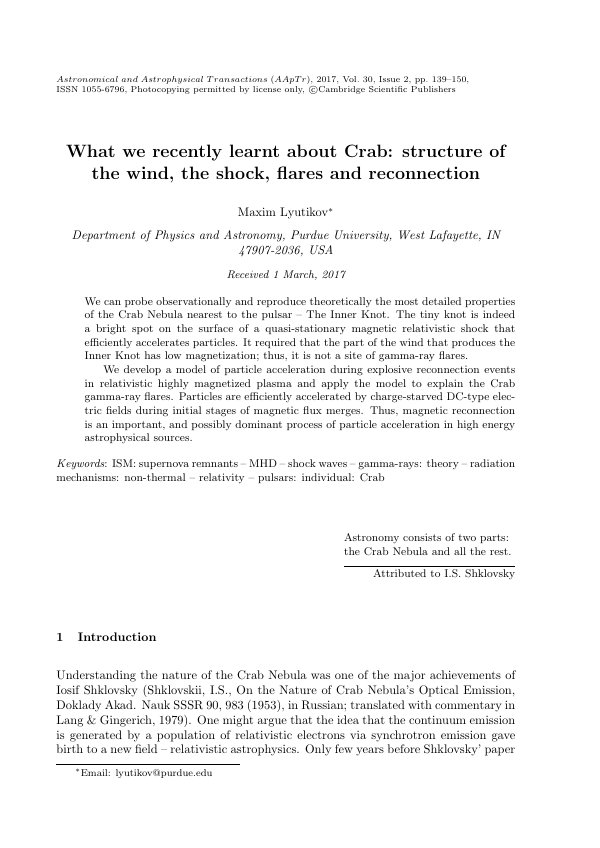
We can probe observationally and reproduce theoretically the most detailed properties of the Crab Nebula nearest to the pulsar - The Inner Knot. The tiny knot is indeed a bright spot on the surface of a quasi-stationary magnetic relativistic shock that efficiently accelerates particles. It required that the part of the wind that produces the Inner Knot has low magnetization; thus, it is not a site of gamma-ray flares. We develop a model of particle acceleration during explosive reconnection events in relativistic highly magnetized plasma and apply the model to explain the Crab gamma-ray flares. Particles are efficiently accelerated by charge-starved DC-type electric fields during initial stages of magnetic flux merges. Thus, magnetic reconnection
is an important, and possibly dominant process of particle acceleration in high energy astrophysical sources.
Abstract
We can probe observationally and reproduce theoretically the most detailed properties of the Crab Nebula nearest to the pulsar - The Inner Knot. The tiny knot is indeed a bright spot on the surface of a quasi-stationary magnetic relativistic shock that efficiently accelerates particles. It required that the part of the wind that produces the Inner Knot has low magnetization; thus, it is not a site of gamma-ray flares. We develop a model of particle acceleration during explosive reconnection events in relativistic highly magnetized plasma and apply the model to explain the Crab gamma-ray flares. Particles are efficiently accelerated by charge-starved DC-type electric fields during initial stages of magnetic flux merges. Thus, magnetic reconnection
is an important, and possibly dominant process of particle acceleration in high energy astrophysical sources.
Lire l’article
PDF de 12 pages, tel qu’imprimé dans la revue, pages 139 à 150. En libre accès.
Pas encore de consultation enregistrée.