Comparaison entre la matrice de cooccurrence et la transformation en ondelettes pour la classification texturales des images HRV (XS) de Spot
Résumé
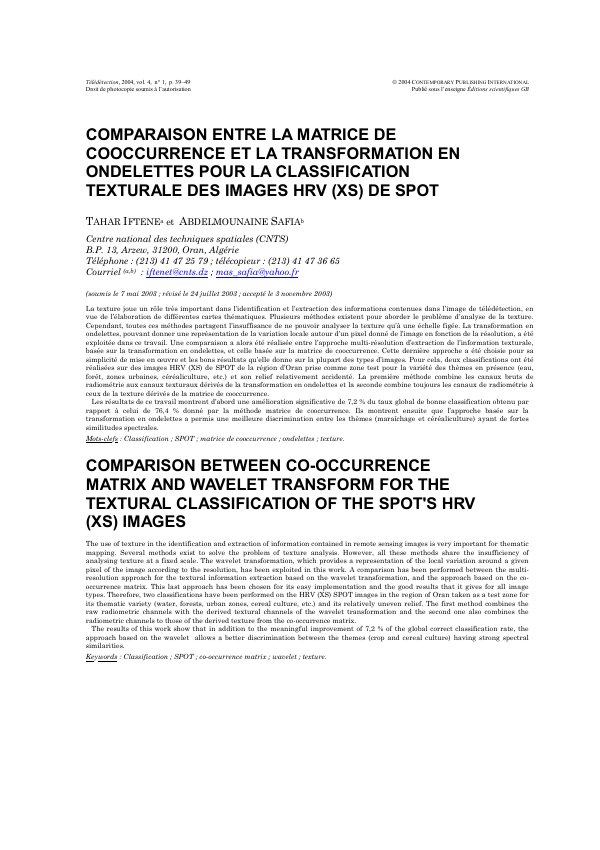
La texture joue un rôle très important dans l’identification et l’extraction des informations contenues dans l’image de télédétection, en vue de l’élaboration de différentes cartes thématiques. Plusieurs méthodes existent pour aborder le problème d’analyse de la texture. Cependant, toutes ces méthodes partagent l’insuffisance de ne pouvoir analyser la texture qu’à une échelle figée. La transformation en ondelettes, pouvant donner une représentation de la variation locale autour d’un pixel donné de l’image en fonction de la résolution, a été exploitée dans ce travail. Une comparaison a alors été réalisée entre l’approche multi-résolution d’extraction de l’information texturale, basée sur la transformation en ondelettes, et celle basée sur la matrice de cooccurrence. Cette dernière approche a été choisie pour sa simplicité de mise en œuvre et les bons résultats qu’elle donne sur la plupart des types d’images. Pour cela, deux classifications ont été réalisées sur des images HRV (XS) de SPOT de la région d’Oran prise comme zone test pour la variété des thèmes en présence (eau, forêt, zones urbaines, céréaliculture, etc.) et son relief relativement accidenté. La première méthode combine les canaux bruts de radiométrie aux canaux texturaux dérivés de la transformation en ondelettes et la seconde combine toujours les canaux de radiométrie à ceux de la texture dérivés de la matrice de cooccurrence.§ Les résultats de ce travail montrent d’abord une amélioration significative de 7,2 % du taux global de bonne classification obtenu par rapport à celui de 76,4 % donné par la méthode matrice de cooccurrence. Ils montrent ensuite que l’approche basée sur la transformation en ondelettes a permis une meilleure discrimination entre les thèmes (maraîchage et céréaliculture) ayant de fortes similitudes spectrales.
Abstract
The use of texture in the identification and extraction of information contained in remote sensing images is very important for thematic mapping. Several methods exist to solve the problem of texture analysis. However, all these methods share the insufficiency of analysing texture at a fixed scale. The wavelet transformation, which provides a representation of the local variation around a given pixel of the image according to the resolution, has been exploited in this work. A comparison has been performed between the multi-resolution approach for the textural information extraction based on the wavelet transformation, and the approach based on the co-occurrence matrix. This last approach has been chosen for its easy implementation and the good results that it gives for all image types. Therefore, two classifications have been performed on the HRV (XS) SPOT images in the region of Oran taken as a test zone for its thematic variety (water, forests, urban zones, cereal culture, etc.) and its relatively uneven relief. The first method combines the raw radiometric channels with the derived textural channels of the wavelet transformation and the second one also combines the radiometric channels to those of the derived texture from the co-occurrence matrix. § The results of this work show that in addition to the meaningful improvement of 7,2 % of the global correct classification rate, the approach based on the wavelet allows a better discrimination between the themes (crop and cereal culture) having strong spectral similarities.
Lire l’article
PDF de 11 pages, tel qu’imprimé dans la revue, pages 39 à 49. En libre accès.
Pas encore de consultation enregistrée.