Raymond Federman : écrivain bilingue, auto-traducteur, traductologue ?
Résumé
Cet article vise à cerner la pensée traductologique de l’écrivain et auto-traducteur franco-américain Raymond Federman (1928-2009) telle qu’elle se dégage de son œuvre phare La Voix dans le débarras/The Voice in the Closet (1979 pour la première édition). Dans cette œuvre bilingue (entre les langues) et en format bilingue, constituée de nombreuses versions, la traduction n’est pas tant le passage d’une langue à l’autre qu’une forme de réécriture, de mouvement perpétuel créant de l’instabilité, rappelant l’impossible nécessité pour Federman de dire son expérience de survivant de la Shoah. Au niveau intertextuel, mais aussi intratextuel, la traduction apparaît à la fois dans la forme des textes et dans une poétique de la répétition, de la digression et du recommencement.
Abstract
This article aims to pinpoint the bilingual writer and self-translator Raymond Federman's (1928-2009) vision of translation as it can be deduced from his flagship work, La Voix dans le débarras / The Voice in the Closet (first edition 1979). This work, which is bilingual (between languages), adopts a bilingual format, and is made up of several versions, conceives of translation not as a crossing over from one language to the other, but as a form of re-writing, a movement that introduces an instability reminiscent of the impossible necessity of telling the experience of surviving the Shoah. Present not only on an intertextual level but also on an intratextual level, translation can be found in the form the texts take on, as well as in the poetics characterized by repetition, digression and perpetual resumption, which make it difficult to locate any beginning or end.
Lire le chapitre
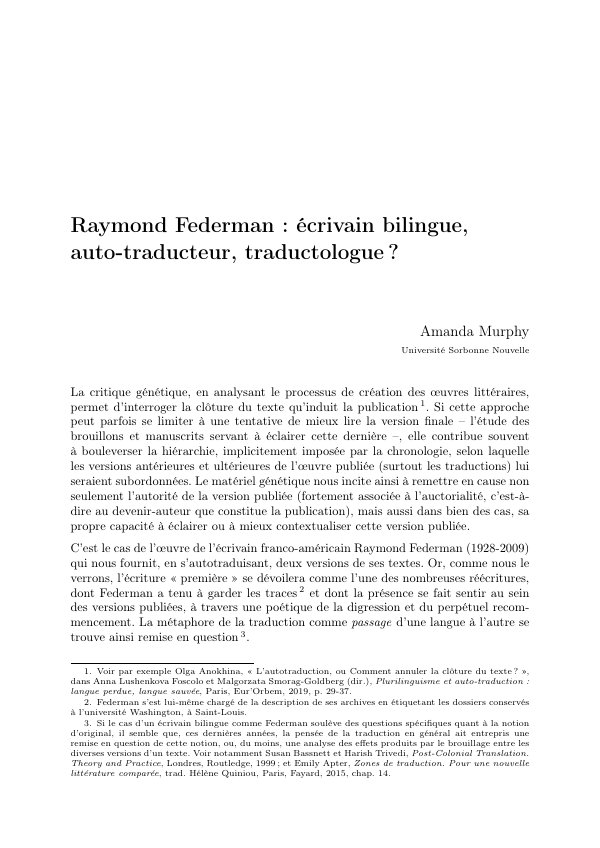
PDF de 12 pages, tel qu’imprimé dans l’ouvrage, pages 133 à 144. En libre accès.
Pas encore de consultation enregistrée.