Carrières de personnes obèses et acquisition de compétences
Résumé
En qualifiant l'obésité d'épidémie mondiale en 2000, l'OMS offre une visibilité plus importante à ce phénomène qui n'a eu de cesse d'évoluer dans la pensée médicale. L'offre de soin pour la traiter s'est développée~: chirurgie bariatrique et éducation thérapeutique en sont les deux modalités principales. Dans le cadre d'un doctorat de sociologie consacré aux enjeux qu'impliquent les transformations des corps obèses pour l'ensemble des acteurs qui gèrent cette maladie, notre interrogation porte sur les compétences dialectiques, singulières et plurielles, qu'ont pu acquérir les patients au fil de leurs carrières. Il s'agit, en effet, d'analyser en quoi ces dispositifs médicaux participent à la construction de nouvelles compétences, notamment en termes de présentation de soi, que ce soit au sein de l'espace spécifique qu'est l'hôpital mais aussi au sein de l'ensemble des sphères dans lesquelles ces malades chroniques sont impliqués. S'inscrivant dans une démarche ethnographique, cette contribution prend appui sur vingt-six entretiens menés avec des patients et l'observation de divers temps collectifs. L'article vise à contribuer aux travaux qui thématisent aussi bien les rapports de domination plus ou moins exprimés par les patients que les conflictualités identitaires et sociales générées par la constitution d'un habitus clivé.
Abstract
Since identifying obesity as a global epidemic in 2000, the WHO has given greater visibility to this phenomenon, which has never ceased to evolve in medical thinking. Thus, care supply towards its treatment has developed: bariatric surgery and therapeutic education are its two main methods.
Within the scope of a PhD in sociology dealing with the stakes involved in the transformation of obese bodies for all those who take part in managing this disease, our questioning focuses on the singular and plural dialectical skills that patients have acquired over the course of their careers. The aim is thus to analyse how these medical devices contribute to the building of new skills, particularly in terms of self-presentation, whether it be within the specific location of the hospital itself but also within all the spheres in which these chronic patients are involved.
As part of an ethnographic approach, this contribution is based on twenty-six interviews with patients and the observation of various group sessions. The article aims to contribute to the works that topicalize the relationships of domination more or less expressed by patients as well as the identity and social conflictualities generated by the constitution of a cleaved habitus.
Lire l’article
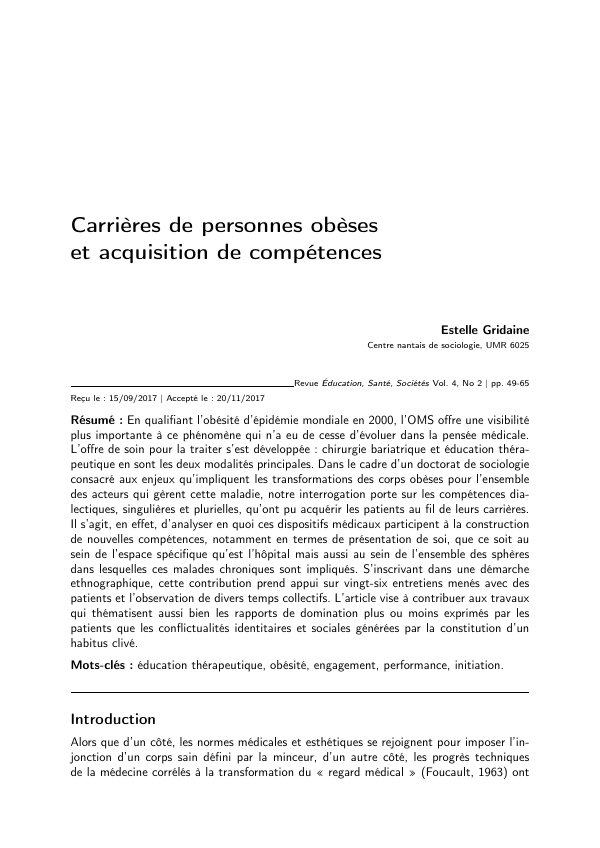
PDF de 17 pages, tel qu’imprimé dans la revue, pages 49 à 65. En libre accès.
Pas encore de consultation enregistrée.